About 1,193 minutes
The plums of New York — A Reader’s Guide
Plants Soil
274,203 recorded words. 60 minutes difference from this book's estimate.
View Gutenberg source #72770
This digital edition of The pears of New York — Context and Discussion is described by source-level measurements including 288,013 words, 20 hr 53 min estimated reading time, and 49 detected text sections.
The text analysis averages about 16.3 words per sentence, while the detected sections provide another way to judge how the source is divided.
Project Gutenberg metadata also associates the work with “Pears,” connecting these edition facts with the source record’s subject description.
Explore this collection
These alternatives are selected using recorded categories and estimated reading time.
About 1,193 minutes
Plants Soil
274,203 recorded words. 60 minutes difference from this book's estimate.
View Gutenberg source #72770About 1,027 minutes
Plants Soil
236,165 recorded words. 226 minutes difference from this book's estimate.
View Gutenberg source #45978About 716 minutes
Plants Soil
164,508 recorded words. 537 minutes difference from this book's estimate.
View Gutenberg source #46327Search stored excerpts and compare books → Choose by your preferences →
Choices use stored catalog measurements. Estimates vary with reading speed. A shared category is a catalog label, not a claim that two books have the same argument or literary quality.
Search reads excerpt text stored with this catalog and links to its associated Gutenberg record. The connection is stored in the site database; this tool does not recheck that every excerpt is word-for-word identical to that external record. Excerpt search does not cover every chapter and does not verify historical publication dates.
Catalog snapshot checked: 2026-09-26. Coverage: 100 public books, 100 available source excerpts.
Calculated from edition completeness, EPUB availability, text structure and catalogue metadata. Not a user rating.
Total of 100 points, scaled to a 2.5-5.0 range. Editions with an empty description or a missing EPUB file are not scored.
Public-domain source text
The source text is kept in the dedicated reader, separate from this catalogue record and its commentary.
The work opens with a formal report to the New York Agricultural Experiment Station, framing the volume as the sixth in a series of monographs on hardy fruits. The preface declares the aim to be a “complete record of the development of the pear wherever cultivated.” This is not a narrative history but a systematic compilation: the bulk of the text consists of alphabetically arranged entries for hundreds of pear varieties, each following a consistent template of origin, physical description, and seasonal notes.
Readers encounter a dense, data-driven structure. Entries like “Chisill” or “Cholwell” include measurements (“medium, ovate-obtuse, mammillate”), color notations (“yellow-ochre, with patches of fawn-colored russet”), and brief assessments of flesh quality. The voice is observational and precise, drawing on pomological records and contemporary reports.
The heart of the book is its alphabetical list of pear varieties, each entry a miniature dossier. For example, the entry for “Chesill” cites John Parkinson in 1629, describing a “delicate mellow pear, even melting as it were in the mouth.” The entry for “Chilton” records a seedling raised by S. A. Shurtleff in Brookline, Massachusetts, exhibited in 1866. “China” notes a pear of Chinese origin reported in Australia in 1867, weighing 16 or 17 ounces, with a “musky pineapple flavor.” These entries blend historical citations, physical measurements, and subjective taste notes.
The catalog’s uniformity allows for easy comparison. Each entry typically includes: origin story, fruit size and shape, skin color and texture, flesh characteristics, season of use, and a quality rating (“very good,” “best”). The language is technical but accessible, using terms like “turbinate,” “mammillate,” and “buttery.” This structure transforms the book into a reference tool for growers and historians alike.
Across entries, certain descriptive elements recur. Skin color is often given in precise hues: “yellow-ochre,” “fawn-colored russet,” “vermillion red.” Texture is noted as “rough to the touch” or “smooth, thin.” Flesh is described as “semi-fine, breaking” or “melting, buttery.” Juice is “sufficient, sugary, rather savory.” These phrases form a consistent vocabulary for evaluating pears.
Seasonal markers are frequent: “second; Jan. and Feb.” or “Oct.” indicate when the fruit is at its best. Quality judgments range from “very good” to “best,” with occasional notes like “acrid” for the “Choak-pear,” whose flesh “produces a choking sensation.” The repetition of these patterns gives the catalog a rhythm, making it easy to scan for specific traits.
The entries span centuries and continents. “Chesill” reaches back to 1629 England, while “Chilton” appears in 1866 Massachusetts. “China” connects to Australia and New South Wales. “Choisnard” was found wild in France around 1810. This temporal and geographic range is a key feature: the book traces the pear’s spread through cultivation and migration.
The movement is not just historical but spatial within the text. Each entry jumps to a new location and time, creating a mosaic of global pear culture. The reader moves from a Huguenot settler’s seedling in New Rochelle (“Church”) to a variety from Cincinnati (“Christmas”) to a French wildling (“Choisnard”). This structure emphasizes the pear as a global fruit, adapted and renamed across regions.
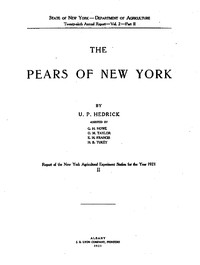
The title page lists U. P. Hedrick as author, assisted by G. H. Howe, O. M. Taylor, E. H. Francis, and H. B. Tukey. The preface notes that “the added years of experience and observation of Dr. Hedrick and his assistants serve to bring each successive monograph to a higher state of excellence.” This collaborative effort is evident in the breadth of entries, which draw on diverse sources: horticultural society reports, nursery catalogs, and personal communications.
The contributors’ voices merge into a single authoritative tone. Entries often cite earlier pomologists like Downing, Leroy, or Miller, creating a chain of knowledge. The book is thus not just a catalog but a synthesis of pomological literature, filtered through the lens of the New York Agricultural Experiment Station. This institutional backing gives the work a sense of reliability and completeness.
Readers approaching this volume should treat it as a reference work to be consulted, not read cover to cover. The alphabetical arrangement invites browsing: one can compare entries for “Beurré” types or trace the history of a single variety. The consistent structure makes it easy to extract data for research or practical cultivation. For those interested in the history of fruit breeding or the material culture of agriculture, this monograph offers a rich, granular record of pear diversity in the early twentieth century.
That rainy afternoon, The Pears of New York kept me company—each entry a quiet patience about bloom and harvest, about place shaping fruit. Somewhere between the Seckel and the Sheldon, I started wondering what other landscapes hide in plain sight. I set it down and picked up Shrubs for Kansas Landscapes — Themes and Context, and found the same steady attentiveness, only westward.
Save your reaction, strongest insight, and memorable passage.