About 80 minutes
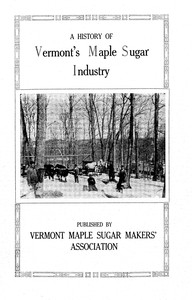
A history of Vermont's maple sugar industry — Themes and Context
Plants Soil
18,392 recorded words. 12 minutes difference from this book's estimate.
View Gutenberg source #72529
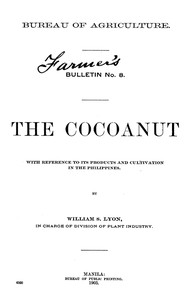
The catalog record for The Cocoanut: With reference to its products and cultivation in the Philippines — A Closer Reading provides practical reading context through 15,636 words, 1 hr 8 min estimated reading time, and 2 detected text sections.
The text analysis averages about 27.6 words per sentence, while the detected sections provide another way to judge how the source is divided.
Project Gutenberg metadata also associates the work with “Coconut palm -- Philippines,” connecting these edition facts with the source record’s subject description.
Explore this collection
These alternatives are selected using recorded categories and estimated reading time.
About 80 minutes
Plants Soil
18,392 recorded words. 12 minutes difference from this book's estimate.
View Gutenberg source #72529About 32 minutes
Plants Soil
7,341 recorded words. 36 minutes difference from this book's estimate.
View Gutenberg source #62234About 118 minutes
Plants Soil
27,096 recorded words. 50 minutes difference from this book's estimate.
View Gutenberg source #57123Search stored excerpts and compare books → Choose by your preferences →
Choices use stored catalog measurements. Estimates vary with reading speed. A shared category is a catalog label, not a claim that two books have the same argument or literary quality.
Search reads excerpt text stored with this catalog and links to its associated Gutenberg record. The connection is stored in the site database; this tool does not recheck that every excerpt is word-for-word identical to that external record. Excerpt search does not cover every chapter and does not verify historical publication dates.
Catalog snapshot checked: 2026-09-26. Coverage: 100 public books, 100 available source excerpts.
Calculated from edition completeness, EPUB availability, text structure and catalogue metadata. Not a user rating.
Total of 100 points, scaled to a 2.5-5.0 range. Editions with an empty description or a missing EPUB file are not scored.
Public-domain source text
The source text is kept in the dedicated reader, separate from this catalogue record and its commentary.
William S. Lyon's 1903 bulletin opens not with planting instructions but with a letter of transmittal and an introduction that immediately establishes a dual audience: the planter seeking practical advice and the curious reader interested in the cocoanut's history and botany. The author acknowledges contributions from a botanist and manufacturers, grounding the text in collaborative expertise. This framing prepares the reader for a work that moves between scientific analysis, local lore, and economic argument.
The opening pages blend two registers. Lyon recounts Visayan folklore—a proverb warns that cruelty to family or animals yields barren husks—alongside a botanical description credited to Don Regino Garcia. This juxtaposition is deliberate: the writer treats traditional beliefs as cultural data, not mere decoration. The folklore appears in the history section, not as a curiosity, but as evidence of how local communities have long observed the tree's behavior. Lyon then pivots to chemical analysis, presenting Mr. Cochran's breakdown of nitrogen, potash, and phosphoric acid per thousand nuts. The transition is abrupt but purposeful: the reader sees that the bulletin will honor local knowledge while subjecting it to empirical scrutiny.
A central technical claim emerges in the cultivation section: common salt, despite popular belief, is injurious to cocoanut soils. Lyon builds his case methodically. He explains that salt combines with lime to form soluble chlorides, which leach away essential bases. He cites the practice of trained planters who apply crude Stassfurt mineral manures well before planting to allow salt to wash out. Then he addresses the counterargument—that cocoanuts can take up salt without injury—by distinguishing between the tree's tolerance and the soil's long-term fertility. The reasoning is detailed and cautious, reflecting the bulletin's role as a corrective to received practice. Readers unfamiliar with soil chemistry will find the argument clearly laid out, though Lyon assumes some familiarity with terms like 'assimilable' and 'leach.'
Lyon observes that Filipino nut growers rarely apply manure systematically after planting, despite the visible benefit to trees near dwellings that receive household waste. He contrasts this with practices in India, Ceylon, and Cochin China, where even the best efforts were minimal until recently. The tone is observational rather than scolding. He then quantifies the drain: 10,000 nuts per hectare per year remove 82½ pounds of nitrogen, 170 of potash, and 30 of phosphoric acid. To contextualize, he compares these figures to tobacco, corn, and cotton, showing that cocoanut is not among the most depleting crops. The numbers serve as a practical baseline for any planter considering fertilizer. The section underscores the bulletin's core tension: abundant local experience coexists with a lack of systematic soil management.
The bulletin's table of contents reveals a deliberate progression: history, botany, uses (copra, oil, coir, tuba), then cultivation (location, soil, seed, planting, manuring, irrigation, harvest, enemies, remedies, renovation). The uses section precedes cultivation, implying that understanding the product informs the growing. Each subsection is short, often a page or less, making the work easy to consult. The 'Enemies' and 'Remedies' sections are brief, suggesting that pest management was not yet a major concern. The final 'Conclusion' is a single page. This structure suits the bulletin's origin as a response to inquiries: it is a reference, not a narrative. Readers should expect to dip in and out, using the headings as a guide.
Lyon's bulletin rewards a reading that moves between its parts. The folklore in the history section gains depth when revisited after the soil chemistry; the manuring critique becomes sharper when set against the uses section's description of copra production. The work is best approached as a layered document—part manual, part natural history, part economic argument—whose value lies in the connections it draws between local practice, scientific measurement, and agricultural improvement.
Reading the old Philippine bulletin, I found myself lingering on how tenderly it treats the coconut’s folklore alongside its soil chemistry. That patient layering reminded me of another quiet volume, The plums of New York — A Reader’s Guide, where each variety’s history seems to rest in the orchard’s own unhurried memory. Both feel less like manuals, more like letters from a gentler time.
Create a short personal record of your experience with this book.