About 118 minutes
Kellogg's Great Crops of Strawberries, and How to Grow Them the Kellogg Way — Key Ideas to Explore
Plants Soil
27,096 recorded words. 16 minutes difference from this book's estimate.
View Gutenberg source #57123
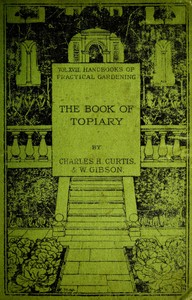
For The book of topiary — Story, Setting & Ideas, the stored edition analysis reports 30,781 words, 2 hr 14 min estimated reading time, and 17 detected text sections.
The text analysis averages about 26.1 words per sentence, while the detected sections provide another way to judge how the source is divided.
Project Gutenberg metadata also associates the work with “Topiary work,” connecting these edition facts with the source record’s subject description.
Explore this collection
These alternatives are selected using recorded categories and estimated reading time.
About 118 minutes
Plants Soil
27,096 recorded words. 16 minutes difference from this book's estimate.
View Gutenberg source #57123About 80 minutes
Plants Soil
18,392 recorded words. 54 minutes difference from this book's estimate.
View Gutenberg source #72529About 68 minutes
Plants Soil
15,636 recorded words. 66 minutes difference from this book's estimate.
View Gutenberg source #33844Search stored excerpts and compare books → Choose by your preferences →
Choices use stored catalog measurements. Estimates vary with reading speed. A shared category is a catalog label, not a claim that two books have the same argument or literary quality.
Search reads excerpt text stored with this catalog and links to its associated Gutenberg record. The connection is stored in the site database; this tool does not recheck that every excerpt is word-for-word identical to that external record. Excerpt search does not cover every chapter and does not verify historical publication dates.
Catalog snapshot checked: 2026-09-26. Coverage: 100 public books, 100 available source excerpts.
Calculated from edition completeness, EPUB availability, text structure and catalogue metadata. Not a user rating.
Total of 100 points, scaled to a 2.5-5.0 range. Editions with an empty description or a missing EPUB file are not scored.
Public-domain source text
The source text is kept in the dedicated reader, separate from this catalogue record and its commentary.
The book opens with a frontispiece of Levens Gardens and a dedication to the art of topiary, quoting Shirley Hibberd's defense of a "well cut peacock." The table of contents reveals a structured progression from early history and the "Crusade against Topiary" to practical chapters on planting, manuring, and management. This framing immediately establishes the work as both a defense and a manual, blending historical argument with hands-on instruction.
The early chapters, as listed in the contents, trace topiary from its "Early History" through a "Golden Age" and into a "Crusade against Topiary" involving Addison and Pope. This historical narrative is not merely academic; it serves to legitimize the practice against its detractors. The authors align themselves with a tradition that values the craft, setting the stage for the practical advice that follows. Readers encountering the book for the first time will note that the defense is woven into the structure, not relegated to a preface.
In the excerpt on planting, the authors offer specific, evidence-based recommendations. They advise against holly and golden privet for clipping, citing holly's "untidy nature" and constant leaf shedding. Instead, they champion yew and boxwood as "the most easily clipped and trained." This preference is grounded in observable traits: yew's slow growth and box's ability to be kept small through clipping. The advice is concrete, avoiding generic praise, and reflects the authors' hands-on experience.
The middle excerpt emphasizes the importance of avoiding overcrowding, stating that trees "too thickly planted never have the same appearance." The authors recommend generous spacing and mulching with farmyard manure, which they call "the best stimulant" for both health and frost protection. They also discuss top dressing for old trees and caution against chemical manures unless necessary. This section reveals a long-term perspective, focusing on sustainable care rather than quick results.
The later excerpts shift to management of established gardens, with advice on liquid manure and the benefits of farmyard manure despite its "unsightliness." The authors' voice is direct and practical, addressing a gardener who is already committed to the craft. The inclusion of illustrations—such as "Crosses and Jugs in Yew" and "A Peacock cut in Yew"—suggests a visual guide for shaping. The tone remains authoritative but accessible, assuming the reader has some prior knowledge of gardening.
Readers approaching this book for the first time will benefit from noting how the authors intertwine historical context with practical instruction. The early chapters provide a rationale for the art, while the later ones offer detailed care techniques. Pay attention to the recurring emphasis on yew and box, and the consistent preference for organic over chemical treatments. This is not a general gardening guide but a specialized manual for a specific horticultural practice.
Sitting with The Book of Topiary, I found myself thinking about the gardener’s patience—how Curtis and Gibson trust the slow, shaping years. That same quiet faith in time seems present in Kellogg's Great Crops of Strawberries, and How to Grow Them the Kellogg Way — Key Ideas to Explore. Different plants, yet the same unhurried hand guiding the soil, waiting for the reward.
Use these questions to collect your thoughts before moving on.