About 134 minutes
The book of topiary — Story, Setting & Ideas
Plants Soil
30,781 recorded words. 16 minutes difference from this book's estimate.
View Gutenberg source #61643
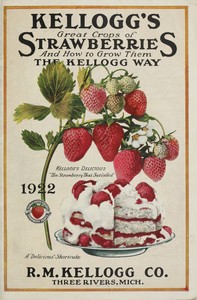
Kellogg's Great Crops of Strawberries, and How to Grow Them the Kellogg Way — Key Ideas to Explore can be approached with a clearer sense of reading commitment from its source measurements: 27,096 words, 1 hr 58 min estimated reading time, and 5 detected text sections.
The text analysis averages about 17.9 words per sentence, while the detected sections provide another way to judge how the source is divided.
Project Gutenberg metadata also associates the work with “Strawberries -- Michigan -- Catalogs,” connecting these edition facts with the source record’s subject description.
Explore this collection
These alternatives are selected using recorded categories and estimated reading time.
About 134 minutes
Plants Soil
30,781 recorded words. 16 minutes difference from this book's estimate.
View Gutenberg source #61643About 80 minutes
Plants Soil
18,392 recorded words. 38 minutes difference from this book's estimate.
View Gutenberg source #72529About 68 minutes
Plants Soil
15,636 recorded words. 50 minutes difference from this book's estimate.
View Gutenberg source #33844Search stored excerpts and compare books → Choose by your preferences →
Choices use stored catalog measurements. Estimates vary with reading speed. A shared category is a catalog label, not a claim that two books have the same argument or literary quality.
Search reads excerpt text stored with this catalog and links to its associated Gutenberg record. The connection is stored in the site database; this tool does not recheck that every excerpt is word-for-word identical to that external record. Excerpt search does not cover every chapter and does not verify historical publication dates.
Catalog snapshot checked: 2026-09-26. Coverage: 100 public books, 100 available source excerpts.
Calculated from edition completeness, EPUB availability, text structure and catalogue metadata. Not a user rating.
Total of 100 points, scaled to a 2.5-5.0 range. Editions with an empty description or a missing EPUB file are not scored.
Public-domain source text
The source text is kept in the dedicated reader, separate from this catalogue record and its commentary.
This 1922 catalog from R. M. Kellogg Co. is a masterclass in persuasive horticultural marketing. The text opens not with strawberries but with credentials: a bank endorsement and a state nursery inspection certificate. These authorial choices immediately establish trust before any plant is described. The prose shifts between authoritative declarations—'Success Demands Progress!'—and intimate customer testimonials, creating a layered rhetorical strategy.
The catalog front-loads institutional endorsements. A full-page letter from the First State Savings Bank vouches for the company's 'strict integrity,' while the Michigan Certificate of Nursery Inspection assures plants are 'free from dangerous insects.' These documents are reproduced verbatim, not summarized. The authorial choice to include official-looking seals and signatures mimics legal or governmental authority. This strategy preempts skepticism about mail-order plant quality, a common concern in 1922. The bank president, F. E. Beatty, is also the company's president—a detail that blurs the line between independent endorsement and self-promotion. The catalog thus constructs a persona of reliability through borrowed credibility.
Customer letters are woven into the sales pitch, each with a name and location. J. A. Gourd of Connecticut reports his wife 'put up 50 quarts for winter' and calls the berries 'the best in town.' These micro-narratives serve as proof of success. The authorial choice to include specific quantities and local details—'50 quarts,' 'in town'—makes the claims feel verifiable. The testimonials are not generic praise; they describe concrete outcomes. This technique transforms the catalog from a list of products into a collection of success stories, inviting the reader to imagine similar results. The dialogue is colloquial, using phrases like 'we expect to do even better next year,' which mimics neighborly advice.
The catalog's diction creates a sense of seasonal urgency. Phrases like 'spring time is planting time' and 'send us your order early' are repeated. The text warns that enthusiasm 'wanes before their resolution can be put into effect,' framing procrastination as a threat to satisfaction. Contrast this with the language of abundance: 'swell your expectations to the highest possible degree' and 'you can’t begin to overestimate the luxurious treat.' The authorial voice oscillates between gentle scolding and lavish promise. The word 'garden' is capitalized and branded—'Kellogg Strawberry Garden'—turning a common noun into a proprietary product. This linguistic move elevates the purchase from mere plants to a complete, branded experience.
Though the excerpts are text-only, the catalog's original layout is evident. Headlines like 'KELLOGG’S BIG FOUR GARDEN' are set in all caps, and prices are bolded: 'Special Delivered Price Only $7.00.' The structure groups plants into named collections—'Big Four Garden,' 'Junior Garden,' 'Everbearing Garden'—each with a fixed price and prepaid delivery. This simplifies decision-making. The authorial choice to bundle varieties reduces choice anxiety and increases perceived value. The catalog also uses photo-engravings referenced in the text (e.g., 'page 45 shows a Kellogg Everbearing Garden fruiting in the fall'), indicating that images were integral to the argument. The text describes the scene: 'fall vegetables, corn in shock and young ladies in fall apparel,' reinforcing the idea of late-season bounty.
Readers of this catalog should attend to how persuasion operates through structure and diction. The blend of institutional authority, customer testimony, and urgent abundance creates a compelling sales document. Notice the careful calibration of trust and desire—each paragraph serves a rhetorical purpose. This is not merely a price list but a carefully constructed argument for a particular way of gardening.
The rain drummed on the window while I lingered over Kellogg’s earnest promises of “great crops,” the old words somehow hushing into the afternoon’s stillness. That same quiet patience, I found, lingered in the luscious weights of another fruit. I closed one catalog and drifted to the other. The plums of New York — A Reader’s Guide holds a kindred, unhurried reverence for what the earth yields.
A brief reflection can help important ideas stay with you longer.