About 1,193 minutes
The plums of New York — A Reader’s Guide
Plants Soil
274,203 recorded words. 166 minutes difference from this book's estimate.
View Gutenberg source #72770
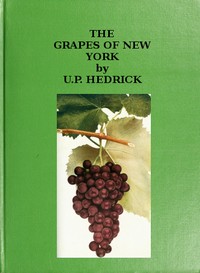
The grapes of New York — Themes and Context can be approached with a clearer sense of reading commitment from its source measurements: 236,165 words, 17 hr 7 min estimated reading time, and 44 detected text sections.
The text analysis averages about 14.9 words per sentence, while the detected sections provide another way to judge how the source is divided.
Project Gutenberg metadata also associates the work with “Viticulture -- New York (State),” connecting these edition facts with the source record’s subject description.
Explore this collection
These alternatives are selected using recorded categories and estimated reading time.
About 1,193 minutes
Plants Soil
274,203 recorded words. 166 minutes difference from this book's estimate.
View Gutenberg source #72770About 1,253 minutes
Plants Soil
288,013 recorded words. 226 minutes difference from this book's estimate.
View Gutenberg source #46994About 716 minutes
Plants Soil
164,508 recorded words. 311 minutes difference from this book's estimate.
View Gutenberg source #46327Search stored excerpts and compare books → Choose by your preferences →
Choices use stored catalog measurements. Estimates vary with reading speed. A shared category is a catalog label, not a claim that two books have the same argument or literary quality.
Search reads excerpt text stored with this catalog and links to its associated Gutenberg record. The connection is stored in the site database; this tool does not recheck that every excerpt is word-for-word identical to that external record. Excerpt search does not cover every chapter and does not verify historical publication dates.
Catalog snapshot checked: 2026-09-26. Coverage: 100 public books, 100 available source excerpts.
Calculated from edition completeness, EPUB availability, text structure and catalogue metadata. Not a user rating.
Total of 100 points, scaled to a 2.5-5.0 range. Editions with an empty description or a missing EPUB file are not scored.
Public-domain source text
The source text is kept in the dedicated reader, separate from this catalogue record and its commentary.
U.P. Hedrick's The Grapes of New York (1908) opens not with a vine but with a bureaucratic chain: a director's letter to the Board of Control, a preface outlining the volume's scope, and a title page that names four assistant authors. This framing immediately establishes the work as an official station report—Part II of the 1907 annual report—rather than a popular guide. The preface declares the book's purpose: to record the state of development of American grapes, using New York as a representative region. For a first-time reader, this institutional origin explains the systematic, data-heavy approach that follows.
The table of contents reveals a clear tripartite structure: historical narratives of Old World and New World grapes, an account of New York's grape regions and industry statistics, and—the bulk of the volume—descriptions of all important American grape varieties. The excerpts show that the variety entries follow a rigid template: synonymy, bibliography, economic status, then a detailed description of vine, leaf, flower, and fruit. This consistency allows a reader to compare entries directly, but the sheer number of varieties (the text runs over 236,000 words) means the book functions more as a reference encyclopedia than a continuous narrative.
The entry for 'Jewel' exemplifies Hedrick's descriptive method. It begins with parentage ('John Burr…grew Jewel from seed of Delaware planted about 1874'), then moves through vine vigor, cane color, leaf shape, flower sterility, and finally berry characteristics. The prose is precise and technical: 'canes intermediate in length and number, slender, light to dark reddish-brown; nodes enlarged, flattened.' A first-time reader should note that Hedrick prioritizes observable, measurable traits over subjective quality—though he does offer evaluative statements ('a most excellent little grape'). The description of 'Kensington' shows a similar pattern, with added emphasis on its hybrid parentage (Riparia, Vinifera, Labrusca).
Throughout the excerpts, parentage serves as a key identifier. 'Jewel' is described in relation to its parent 'Delaware,' with comparisons of color, flavor, and disease resistance. 'Kensington' is introduced as 'chiefly interesting as a cross between Riparia and Vinifera.' This emphasis reflects the book's historical moment: American viticulture in the early 1900s was deeply engaged in hybridizing native species with European Vitis vinifera to create hardy, disease-resistant varieties. A reader unfamiliar with grape taxonomy will encounter terms like 'Labrusca' and 'Riparia' repeatedly; the book assumes some botanical knowledge.
The excerpts mention an 'Index to Illustrations' and a 'Bibliography and references with abbreviations used,' indicating that the printed edition included plates and a scholarly apparatus. The transcriber's note warns that some illustrations have been moved from mid-paragraph for ease of reading, and that clicking a symbol may bring up a larger image. For a first-time reader of the digital edition, these features are crucial: the illustrations likely depict grape clusters, leaves, and vines, and the bibliography provides the scientific foundation for Hedrick's descriptions. The index (A–Z) suggests the book is designed for targeted lookup, not cover-to-cover reading.
First-time readers will benefit from approaching The Grapes of New York as a reference work rather than a monograph. The opening institutional framing, the consistent variety-entry template, and the emphasis on hybrid parentage all reward selective reading: consult the historical sections for context, then use the descriptions to identify specific grapes. The book's value lies in its systematic documentation of early 20th-century American grape varieties, many of which have since declined in commercial importance.
I’ve often marveled at how Hedrick’s Grapes of New York treats each vine’s tangled parentage as a quiet family story. That patient, unhurried attention to hidden lineage reminds me of leafing through The book of topiary — Story, Setting & Ideas, where clipped shapes whisper of gardeners’ hands working years, waiting for a form to settle into calm, deliberate being.
Build a private reading journal entry for this title.