About 175 minutes
Mushroom Culture: Its Extension and Improvement — Story, Setting & Ideas
Farming
40,164 recorded words. 15 minutes difference from this book's estimate.
View Gutenberg source #40952

The Pecan and its Culture — A Reader’s Guide can be approached with a clearer sense of reading commitment from its source measurements: 36,650 words, 2 hr 40 min estimated reading time, and 7 detected text sections.
The text analysis averages about 17.3 words per sentence, while the detected sections provide another way to judge how the source is divided.
Project Gutenberg metadata also associates the work with “Pecan,” connecting these edition facts with the source record’s subject description.
Explore this collection
These alternatives are selected using recorded categories and estimated reading time.
About 175 minutes
Farming
40,164 recorded words. 15 minutes difference from this book's estimate.
View Gutenberg source #40952About 127 minutes
Farming
29,077 recorded words. 33 minutes difference from this book's estimate.
View Gutenberg source #63344About 203 minutes
Farming
46,664 recorded words. 43 minutes difference from this book's estimate.
View Gutenberg source #20917Search stored excerpts and compare books → Choose by your preferences →
Choices use stored catalog measurements. Estimates vary with reading speed. A shared category is a catalog label, not a claim that two books have the same argument or literary quality.
Search reads excerpt text stored with this catalog and links to its associated Gutenberg record. The connection is stored in the site database; this tool does not recheck that every excerpt is word-for-word identical to that external record. Excerpt search does not cover every chapter and does not verify historical publication dates.
Catalog snapshot checked: 2026-09-26. Coverage: 100 public books, 100 available source excerpts.
Calculated from edition completeness, EPUB availability, text structure and catalogue metadata. Not a user rating.
Total of 100 points, scaled to a 2.5-5.0 range. Editions with an empty description or a missing EPUB file are not scored.
Public-domain source text
The source text is kept in the dedicated reader, separate from this catalogue record and its commentary.
H. Harold Hume opens The Pecan and its Culture by declaring that the pecan has "rapidly emerged from a wild or semi-wild condition to the status of an orchard nut." This 1906 manual, written while Hume was based in Petersburg, Virginia, reflects a transitional moment in American horticulture when native fruits were gaining systematic attention. The book is organized into six parts covering botany, varieties, cultivation, harvesting, diseases, and uses, with numerous illustrations of nuts, tools, and grafting techniques.
Hume writes with the authority of a practitioner, not a distant academic. His prose is direct and instructional, often drawing on specific field experiments—such as planting nuts on quicksand to observe root failure. The work is grounded in observable detail rather than abstract theory, making it a valuable record of early twentieth-century pecan science.
Hume's botanical chapter is not a dry recitation of Linnaean categories. He describes pecan flowers, for instance, with an eye toward the orchardist: the tree's flowering habits directly affect pollination and nut set. His language is precise but accessible, as when he notes that on "extremely rich soils, the pecan will make wood growth at the expense of fruit." This observation ties plant physiology directly to practical management. He also discusses hybrids, such as those between Hicoria minima and the pecan, illustrating them with figures. The botanical section serves as a foundation for later cultural advice, not as a standalone treatise.
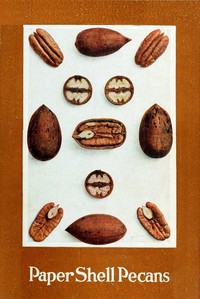
The variety descriptions form the core of the book's second part. Hume catalogs dozens of named cultivars—Curtis, Money-maker, San Saba, Stuart, Schley, and others—each with notes on nut size, shell thickness, kernel quality, and tree vigor. He includes photographs of nuts arranged to show "uniformity in size, color and shape." The chapter on pecan judging outlines criteria for evaluating nuts at exhibitions, reflecting the era's interest in standardization. Hume is careful to note that variety performance depends on local conditions, warning that "there is always an unknown personal equation entering into the problem" of choosing what to plant.
Hume devotes considerable attention to soil preparation, emphasizing that "the soil cannot be prepared for trees as well after they are planted as it can before." He recommends clearing timber, cultivating for a year, and sowing leguminous crops like cowpeas or beggarweed to build nitrogen and humus. His description of a taproot stopped by quicksand—"thick and stocky, was not more than six inches long"—is a vivid example of his observational method. He also advises against planting on "damp, soggy lands" unless drained and limed. The soil section is a model of applied ecology, linking root behavior to subsoil conditions.
The cultural chapters cover propagation techniques in detail: annular budding, veneer shield-budding, chip-budding, cleft grafting, and whip grafting. Hume includes diagrams of budding knives and grafting irons, and he describes top-working old trees to new varieties. Pruning advice is minimal but practical, focused on shaping young trees and removing dead wood. The tone throughout is that of a teacher demonstrating a craft: "Better by all means to spend a year or more in getting the land in shape." Hume's emphasis on preparation and patience reflects his belief that successful pecan culture depends on careful, unhurried work.
Readers approaching The Pecan and its Culture will find a work that balances scientific observation with hands-on advice. Hume does not promise easy success; he insists on thorough soil preparation, variety selection suited to local conditions, and ongoing management of pests and diseases. The book is best read as a period document of American pomology, valuable for its specific descriptions of cultivars and cultural practices that shaped the pecan industry. Those interested in the history of horticulture or in growing pecans themselves will find Hume's direct, evidence-based approach instructive.
Reading Hume’s quiet, methodical notes on pecan soil and scab, I felt that same patient wonder I once found in a yellowed guide to native grapes and American wine. Both are less instructions than a gardener’s long dialogue with place—working with what the land offers, not against it. The hand that wrote The Cultivation of The Native Grape, and Manufacture of American Wines — Themes and Context seems to have known that same unhurried season of trial.
Use these questions to collect your thoughts before moving on.