About 349 minutes
The Vegetable Garden: What, When, and How to Plant — Edition Insights
Farming
80,189 recorded words. 35 minutes difference from this book's estimate.
View Gutenberg source #43531
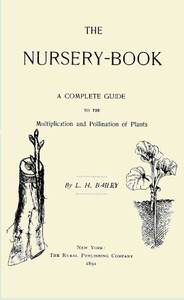
The source record for The Nursery-Book: A Complete Guide to the Multiplication and Pollination of Plants — Text and Context measures this digital text at 88,160 words, 6 hr 24 min estimated reading time, and 18 detected text sections.
The text analysis averages about 14.8 words per sentence, while the detected sections provide another way to judge how the source is divided.
Project Gutenberg metadata also associates the work with “Plant propagation,” connecting these edition facts with the source record’s subject description.
Explore this collection
These alternatives are selected using recorded categories and estimated reading time.
About 349 minutes
Farming
80,189 recorded words. 35 minutes difference from this book's estimate.
View Gutenberg source #43531About 541 minutes
Farming
124,222 recorded words. 157 minutes difference from this book's estimate.
View Gutenberg source #54790About 203 minutes
Farming
46,664 recorded words. 181 minutes difference from this book's estimate.
View Gutenberg source #20917Search stored excerpts and compare books → Choose by your preferences →
Choices use stored catalog measurements. Estimates vary with reading speed. A shared category is a catalog label, not a claim that two books have the same argument or literary quality.
Search reads excerpt text stored with this catalog and links to its associated Gutenberg record. The connection is stored in the site database; this tool does not recheck that every excerpt is word-for-word identical to that external record. Excerpt search does not cover every chapter and does not verify historical publication dates.
Catalog snapshot checked: 2026-09-26. Coverage: 100 public books, 100 available source excerpts.
Calculated from edition completeness, EPUB availability, text structure and catalogue metadata. Not a user rating.
Total of 100 points, scaled to a 2.5-5.0 range. Editions with an empty description or a missing EPUB file are not scored.
Public-domain source text
The source text is kept in the dedicated reader, separate from this catalogue record and its commentary.
L. H. Bailey's The Nursery-Book (1891) is structured as a practical reference, not a narrative. Its core is an extensive alphabetical 'Nursery List' detailing propagation methods for hundreds of plants, from Chionodoxa to Cistus. The work opens with a preface that explicitly limits its scope to 'an account of the methods commonly employed,' avoiding discussion of ultimate results or influences. This encyclopedic format, with entries typically one to three paragraphs, allows rapid consultation. Bailey draws on multiple sources, including Nicholson's Illustrated Dictionary of Gardening and Vilmorin's Les Fleurs de Pleine Terre, and the text was reviewed by skilled propagators, including B. M. Watson Jr. of Harvard's Bussey Institution. The result is a dense, authoritative guide that prioritizes actionable instruction over botanical theory.
The book's primary organizational device is the alphabetical nursery list, which occupies the bulk of the text. Each entry, such as those for Chrysanthemum or Cineraria, follows a consistent pattern: the plant's family, then specific propagation methods—seeds, cuttings, division, grafting—often with seasonal timing. For Chrysanthemum, Bailey specifies that cuttings should be 'about three inches long,' made in spring, and placed 'near the glass of a rather close frame having a temperature of about 45°.' This uniformity allows readers to quickly locate a plant and its recommended technique. The list is not exhaustive but aims to cover 'all the plants which are ordinarily grown by horticulturists in this country either for food or ornament,' as stated in the preface. The structure reflects a taxonomic approach, grouping related genera (e.g., Chrysocoma, Chrysogonum, Chrysopsis) but treating each independently.
Throughout the entries, a set of recurring physical actions defines the propagator's work: cutting, inserting, pressing, watering. For Cissus, Bailey describes taking 'cuttings in the spring' from 'weakly shoots that are pruned,' and for Cistus, 'cuttings under frames.' The language is precise: cuttings are 'inserted in sandy soil,' 'placed in a gentle heat,' or 'plunged in strong, moist heat.' The image of the cutting—a severed piece of stem or root—is central, and the text repeatedly emphasizes the conditions needed for rooting: sand, glass, bottom heat, and firm soil. For Choisya, 'ripened cuttings' are specified; for Chrysanthemum, leaf cuttings are noted as an alternative. This focus on the cutting as a unit of propagation reinforces the book's practical, hands-on orientation, where success depends on precise manipulation of plant parts.
Bailey moves fluidly from general propagation principles to species-specific instructions. The preface outlines the book's scope, but the entries themselves often embed general advice within specific contexts. For Cineraria, he recommends a soil mix of 'light leaf-mould' with 'fresh sifted loam and sharp sand,' and notes that 'old cow manure is a good medium in which to sow.' This detail is particular to Cineraria, yet the method—mixing soil components for seed starting—applies broadly. Similarly, for Chrysanthemum, the instruction to 'press the soil firmly, and water' after inserting cuttings is a universal step. The text thus serves as both a species-specific guide and a repository of general technique, allowing the reader to infer broader practices from individual entries. This dual movement is a key structural feature, linking the particular to the general without explicit cross-referencing.
Bailey explicitly acknowledges his sources and collaborators, embedding the book within a network of contemporary horticultural expertise. The preface credits 'the head propagator of one of the largest nurseries in this country' for advice on hardy ornamentals, and B. M. Watson Jr. for reviewing the entire volume. W. J. Bean of the Royal Gardens, Kew, contributed articles on orchids. Bailey also drew on Nicholson's Illustrated Dictionary of Gardening, Vilmorin's Les Fleurs de Pleine Terre, and other standard references. This collaborative framework lends authority to the instructions, as the text claims that 'all such directions as are commonly recommended in other countries have also been sanctioned, if admitted, as best for this.' The result is a synthesis of international practice adapted to American conditions, a point emphasized by the inclusion of both domestic and foreign sources.
Readers approaching The Nursery-Book should treat it as a reference to be consulted, not read straight through. The alphabetical list rewards browsing: a gardener seeking advice on Chionodoxa will find adjacent entries for Chironia and Chives, each with distinct methods. The preface's disclaimer—that the book does not discuss 'ultimate results or influences'—is a useful reminder that this is a manual of technique, not plant physiology. For modern readers, the specific soil mixes and temperatures offer a window into late-19th-century practice, while the collaborative authorship highlights the era's emerging professionalization of horticulture.
That rainy afternoon, the 1891 nursery book’s careful diagrams of cleft grafts felt like quiet company. I kept drifting to the tomatoes, their patient, obsessive cross-pollination notes. Hours later, still damp outside, I found myself reaching for The Tomato — Edition Insights, almost without thinking. It wasn’t a plan; just the same lingering curiosity, ripening on the page.
Answer a few questions and save a private reflection on this device.