About 105 minutes
Woodward's Graperies and Horticultural Buildings — Themes and Context
Farming
24,016 recorded words. 22 minutes difference from this book's estimate.
View Gutenberg source #25373
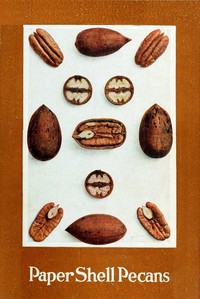
Paper Shell Pecans — Context and Discussion can be approached with a clearer sense of reading commitment from its source measurements: 29,077 words, 2 hr 7 min estimated reading time, and 58 detected text sections.
The text analysis averages about 21.1 words per sentence, while the detected sections provide another way to judge how the source is divided.
Project Gutenberg metadata also associates the work with “Pecan,” connecting these edition facts with the source record’s subject description.
Explore this collection
These alternatives are selected using recorded categories and estimated reading time.
About 105 minutes
Farming
24,016 recorded words. 22 minutes difference from this book's estimate.
View Gutenberg source #25373About 97 minutes
Farming
22,261 recorded words. 30 minutes difference from this book's estimate.
View Gutenberg source #38051About 160 minutes
Farming
36,650 recorded words. 33 minutes difference from this book's estimate.
View Gutenberg source #28065Search stored excerpts and compare books → Choose by your preferences →
Choices use stored catalog measurements. Estimates vary with reading speed. A shared category is a catalog label, not a claim that two books have the same argument or literary quality.
Search reads excerpt text stored with this catalog and links to its associated Gutenberg record. The connection is stored in the site database; this tool does not recheck that every excerpt is word-for-word identical to that external record. Excerpt search does not cover every chapter and does not verify historical publication dates.
Catalog snapshot checked: 2026-09-26. Coverage: 100 public books, 100 available source excerpts.
Calculated from edition completeness, EPUB availability, text structure and catalogue metadata. Not a user rating.
Total of 100 points, scaled to a 2.5-5.0 range. Editions with an empty description or a missing EPUB file are not scored.
Public-domain source text
The source text is kept in the dedicated reader, separate from this catalogue record and its commentary.
This book opens with a photograph caption boasting “sixteen big pecan nuts on a single small lower branch,” immediately establishing the tone of exuberant agricultural boosterism. Published by the Keystone Pecan Company, the work is part orchard manual, part nutritional tract, and part investment prospectus. Its language shifts between the practical—describing soil adaptability and tree yields—and the evangelical, urging readers to replace animal flesh with nut meat. The narrative voice is that of a confident promoter, citing government statistics and food authorities to build credibility. The pace alternates between detailed agronomic descriptions and broad economic arguments, creating a hybrid text that is as much a sales pitch as a guide to pecan cultivation.
The book devotes several chapters to advocating for nuts as a staple food, arguing that “nut meat gives fat and all needed protein.” It draws on authorities like Dr. J. H. Kellogg and Dr. Harvey W. Wiley to support claims that pecans can replace meat. The language is urgent: “Shall We Cease to Eat Meat?” is posed as a rhetorical question, answered with statistics from the U.S. Food Administration. The prose often repeats key phrases, such as “less animal flesh—more pecan meat,” creating a rhythmic, persuasive cadence. This section relies heavily on external endorsements rather than original research, reflecting the promotional purpose of the text.
The latter half of the book details the “Unit Plan,” where investors buy land and receive planted trees, with the company managing cultivation for five years. The language becomes contractual: “All trees that die replaced without charge.” The cooperative profit-sharing system promises 87.5% of profits to the owner after expenses. The text emphasizes safety and growth, claiming “each acre-unit increases in value $100.00 a year.” Testimonials from owners who visited the plantation are included, though the excerpts do not reveal their specific experiences. The pace here slows, with dense paragraphs explaining terms and benefits, contrasting with the earlier nutritional fervor.
The book uses photographs as evidence, stating “all illustrations … were made from photographs taken on our plantations.” One image shows “row after row of fine, big pecan trees” with a man for scale, visually reinforcing claims of productivity. The table of contents reveals a structure that moves from general economic value to specific investment details, with repeated page numbers for key topics—a technique that guides readers toward the sales proposition. The voice remains consistent: confident, data-laden, and future-oriented, often invoking “boundless possibilities” from the Congressional Record. This structural layering of visual and textual persuasion creates a cumulative argument for pecan growing as both a moral and financial good.
The pacing of the book varies noticeably between sections. Early chapters on nutrition are brisk, with short paragraphs and frequent exclamations. Later investment sections become more methodical, using bullet-like lists and legalistic phrasing. The register shifts from the quasi-scientific (“maximum food value in condensed form”) to the promotional (“a golden opportunity within the reach of all investors”). This alternation keeps the reader engaged while gradually building the case for purchase. The final pages return to a broader vision, quoting the Congressional Record to frame pecan growing as a national industry. The overall effect is a carefully orchestrated crescendo from dietary advice to financial proposition.
Readers should approach this text as a period piece that reveals early-20th-century marketing strategies for agricultural investments. The blend of nutritional science, cooperative economics, and visual evidence reflects a specific moment in American food and business history. Pay attention to how the authors use authority figures and government data to support claims, and note the recurring emphasis on yield and profit. The book is less a neutral guide than a persuasive document designed to convert readers into investors.
Flipping through Paper Shell Pecans, I kept pausing at its earnest confidence—the belief that a single tree could anchor a family’s future. It reminded me of another old promoter’s dream, the one tucked inside The Raisin Industry A practical treatise on the raisin grapes, their history, culture and curing — A Closer Reading, where grapes, not nuts, promised the same golden horizon. Both feel like letters from a sunnier time, hopeful and slightly sun-worn.
A brief reflection can help important ideas stay with you longer.