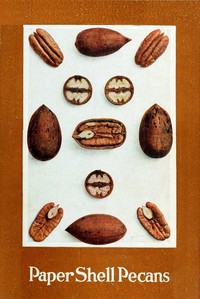
About 160 minutes
The Pecan and its Culture — A Reader’s Guide
Farming
36,650 recorded words. 15 minutes difference from this book's estimate.
View Gutenberg source #28065
The source record for Mushroom Culture: Its Extension and Improvement — Story, Setting & Ideas measures this digital text at 40,164 words, 2 hr 55 min estimated reading time, and 6 detected text sections.
The text analysis averages about 24.4 words per sentence, while the detected sections provide another way to judge how the source is divided.
Project Gutenberg metadata also associates the work with “Mushroom culture,” connecting these edition facts with the source record’s subject description.
Explore this collection
These alternatives are selected using recorded categories and estimated reading time.
About 160 minutes
Farming
36,650 recorded words. 15 minutes difference from this book's estimate.
View Gutenberg source #28065About 203 minutes
Farming
46,664 recorded words. 28 minutes difference from this book's estimate.
View Gutenberg source #20917About 127 minutes
Farming
29,077 recorded words. 48 minutes difference from this book's estimate.
View Gutenberg source #63344Search stored excerpts and compare books → Choose by your preferences →
Choices use stored catalog measurements. Estimates vary with reading speed. A shared category is a catalog label, not a claim that two books have the same argument or literary quality.
Search reads excerpt text stored with this catalog and links to its associated Gutenberg record. The connection is stored in the site database; this tool does not recheck that every excerpt is word-for-word identical to that external record. Excerpt search does not cover every chapter and does not verify historical publication dates.
Catalog snapshot checked: 2026-09-26. Coverage: 100 public books, 100 available source excerpts.
Calculated from edition completeness, EPUB availability, text structure and catalogue metadata. Not a user rating.
Total of 100 points, scaled to a 2.5-5.0 range. Editions with an empty description or a missing EPUB file are not scored.
Public-domain source text
The source text is kept in the dedicated reader, separate from this catalogue record and its commentary.
W. Robinson opens his manual with a fourfold argument: mushroom culture is under-practised in Britain despite abundant materials; existing accounts are too complex for amateurs; growers confine themselves to narrow methods; and the vast cave systems near Paris offer a model worth importing. He visited those caverns in 1868, and the book repeatedly contrasts French large-scale production with English garden-scale beds. Robinson’s tone is direct and reformist—he wants to multiply the supply tenfold and eliminate the ‘waste of money for Mushroom-spawn’ by teaching readers to make their own.
Robinson structures the book around a central tension: the standard English method (small beds in heated houses) versus the French system of vast limestone caverns. He describes the Paris caves as ‘mouth of mushroom-cave’ and ‘bottom of shaft’ in his illustrations, and he visited them specifically to document their scale. Yet he does not advocate wholesale imitation; instead, he adapts principles—using stable manure, controlling temperature, spawning in layers—for British conditions. The reader is asked to see the mushroom not as a hothouse luxury but as a crop that can be grown in cellars, sheds, or even open fields. Robinson’s evidence is practical: he notes that French growers achieve continuous production by exploiting natural underground climates, while English gardeners rely on artificial heat. The contrast is never merely descriptive; it is a call to expand the imagination of what a mushroom bed can be.
A recurring pattern in the excerpts is Robinson’s insistence that spawn—the mycelium used to start beds—can be made at home with no special equipment. He writes that ‘every farmer and country gentleman can make it as easily as, or more easily than, the spawn-manufacturer’. The method is simple: gather short stable manure, form a potato-pit-shaped bed, spawn it with a small amount of purchased or found spawn, let the mycelium run through, then dry the resulting material for later use. Robinson even suggests employing ‘a number of boys, guided by an experienced workman’ for large-scale production. This DIY ethic extends to the planting technique: he describes ‘T-planting’ with a spade to insert spawn into meadows, and advises varying the depth so that ‘one piece of a flake may be at a depth of six inches’ while others touch the surface. The goal is self-sufficiency, reducing reliance on seedsmen and their ‘stiff, brick-like pieces of nursery spawn’.
Robinson’s vision for extending mushroom culture includes growing them in pastures and among field crops like turnips and mangold-wurtzel. He argues that if mushrooms thrive under broccoli in gardens, they should succeed under field vegetables. But he draws a sharp line at kept lawns: ‘It is scarcely desirable to attempt the culture in kept lawns, as no matter how suitable these are for it, the appearance of a large crop of mushrooms would have anything but a tendency to beautify the carpet of turf, and would probably become offensive from their odour.’ This remark reveals a practical aesthetic—the mushroom is a crop, not an ornament. The tension between utility and beauty runs through the text: Robinson wants abundance, but not at the cost of ruining a gentleman’s lawn. His advice is consistently concrete: spawn in May, insert pieces six to ten feet apart, press the ground firm with the foot. The evidence suggests a writer who thinks in terms of soil, labour, and yield, not abstract theory.
Robinson’s book is best read as a working manual rather than a botanical treatise. The excerpts show a writer who trusts observation over authority—he visited Paris, tested methods, and urges readers to do the same. Pay attention to the recurring emphasis on self-made spawn and the rejection of commercial shortcuts; these are the practical core of his argument. The cave system remains a tantalising reference point, but the real value lies in the detailed, step-by-step instructions for beds, meadows, and field crops. Robinson assumes his reader has access to stable manure and a spade, and he writes accordingly.
Reading Robinson’s quiet conviction that mushrooms could thrive in any damp English corner reminded me of another patient faith—that pecans, too, might find a home beyond their usual shores. There’s a tenderness in old horticultural manuals, a belief in steady hands and good soil. I found myself reaching for The Pecan and its Culture — A Reader’s Guide the same evening, and somehow the two sat well together, like old acquaintances exchanging memories of sunnier seasons.
Save your reaction, strongest insight, and memorable passage.