About 864 minutes
The book of the cat — Themes and Context
Gardening
198,648 recorded words. 248 minutes difference from this book's estimate.
View Gutenberg source #76311
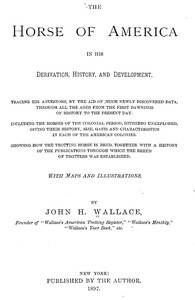
The catalog record for The Horse of America in His Derivation, History, and Development — A Reader’s Guide provides practical reading context through 255,757 words, 18 hr 32 min estimated reading time, and 44 detected text sections.
The text analysis averages about 22.0 words per sentence, while the detected sections provide another way to judge how the source is divided.
Project Gutenberg metadata also associates the work with “Horse breeds -- History,” connecting these edition facts with the source record’s subject description.
Explore this collection
These alternatives are selected using recorded categories and estimated reading time.
About 864 minutes
Gardening
198,648 recorded words. 248 minutes difference from this book's estimate.
View Gutenberg source #76311About 863 minutes
Gardening
198,364 recorded words. 249 minutes difference from this book's estimate.
View Gutenberg source #49245About 800 minutes
Gardening
183,861 recorded words. 312 minutes difference from this book's estimate.
View Gutenberg source #9478Search stored excerpts and compare books → Choose by your preferences →
Choices use stored catalog measurements. Estimates vary with reading speed. A shared category is a catalog label, not a claim that two books have the same argument or literary quality.
Search reads excerpt text stored with this catalog and links to its associated Gutenberg record. The connection is stored in the site database; this tool does not recheck that every excerpt is word-for-word identical to that external record. Excerpt search does not cover every chapter and does not verify historical publication dates.
Catalog snapshot checked: 2026-09-26. Coverage: 100 public books, 100 available source excerpts.
Calculated from edition completeness, EPUB availability, text structure and catalogue metadata. Not a user rating.
Total of 100 points, scaled to a 2.5-5.0 range. Editions with an empty description or a missing EPUB file are not scored.
Public-domain source text
The source text is kept in the dedicated reader, separate from this catalogue record and its commentary.
John H. Wallace opens his 1897 study with a bold claim: previous horse histories merely reproduced what had been printed before. He positions his volume as the first attempt in any language to determine the horse's original habitat and trace its historical distribution. The preface signals a debunking intent, warning that facts about the horse's introduction into Egypt and Arabia, and the plebeian blood behind English racehorses, will shock romanticists. Wallace insists that only the horse that 'has gone out and done it' deserves recognition, dismissing claims of royal Arabian blood as fiction.
The excerpts focus heavily on the trotting sire Electioneer, offering detailed performance data and progeny records. Wallace includes tables of leading sons and their standard performers, emphasizing that Electioneer's family, dating from 1878, outpaces any comparable line. The text blends historical argument with statistical evidence, reflecting Wallace's dual role as author and founder of the American Trotting Register.
Wallace's preface directly confronts prevailing narratives about horse ancestry. He states that the introduction of the horse into Egypt and, two thousand years later, into Arabia, along with the plebeian blood underlying English racehorses, will be 'a shock to the nerves of the romanticists.' This is not a neutral survey but a polemical work aimed at debunking claims of Arabian superiority. Wallace asserts that he cannot recognize any blood as 'royal' except that proven by performance—'the horse that has gone out and done it.' The excerpts do not provide his full argument, but the tone is combative and evidence-driven, relying on historical facts and well-known experiences as he puts it.
A substantial portion of the excerpts is devoted to the trotting sire Electioneer, who died in 1890. Wallace presents a table of 'Leading Sons of Electioneer' listing names, foaling years, and counts of standard performers, producing sons and daughters, and totals over two generations. For instance, Saint Bell (2:24½) produced 47 standard performers, while Sphinx (2:20½) produced 43. Wallace notes that Electioneer's first crop of foals at Palo Alto in 1878 numbered seven, and by 1896 he had 154 standard performers to his credit. The text includes specific race records: Fred Crocker trotted a two-year-old record of 2:25¾ in 1880, and Sunol captured the world's record at 2:08¼ in 1891. These details ground the narrative in verifiable performance data rather than general praise.
Wallace identifies a blank in American horse history: a century of colonial racing that previous writers had not attempted to supply. He argues that understanding the horse of the Colonial period—its size, gait, qualities, and capacities—is essential to comprehending modern trotting and running performances. The excerpts do not reveal his findings on colonial horses, but the preface establishes this as a key contribution. Wallace's approach is to fill a historical gap with data, contrasting with earlier works he dismisses as 'merely reproductions.' This section of the book promises to provide new evidence from the colonial era, though the excerpts only hint at its content.
Readers should approach this work as a specialized historical argument rather than a comprehensive survey. Wallace's focus on debunking Arabian blood claims and his reliance on trotting statistics reflect his background as a register founder. The excerpts suggest the book is most valuable for its detailed progeny records and its challenge to romanticized equine history. Those interested in breed development or American racing history will find specific data, but the complete colonial analysis remains outside these excerpts.
That rain fell all afternoon while I followed Wallace’s patient dismantling of Arabian pedigree myths, his Electioneer line becoming a quiet anchor. Afterwards, tidying the shelf, my hand brushed a similar old companion—one about bees and their orderly, profitable hives, another creature whose history turns on patient observation rather than romance. Bee-keeping for profit — Reading Companion felt like the same steady, unadorned truth-telling, just a different pasture.
A brief reflection can help important ideas stay with you longer.









