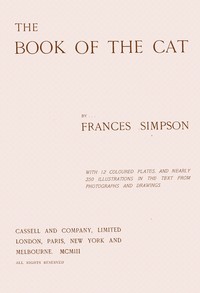
Frances Simpson's The Book of the Cat (1903) opens with a frontispiece of a Black Persian painted by Madame Henriette Ronner, then proceeds through thirty-two chapters that blend breed history, show standards, and practical advice. The table of contents alone reveals a meticulous taxonomy: Persians are subdivided by colour—Black, White, Blue, Silver, Smoke, Orange, Cream, Tortoiseshell, and more—each with its own chapter. Later sections cover Manx, Siamese, short-haired cats, foreign breeds, and even cat photography for amateurs.
The excerpts show that Simpson relied heavily on correspondence with breeders and exhibitors, quoting letters and show reports. For example, the cream cat "Matthew of the Durhams" is described through a reporter's florid praise in Our Cats, while the cream female "Wynnstay Myrtle" is noted for her influence on future breeding. This network of named owners and catteries gives the book a documentary quality, recording the social world of Edwardian cat fancy.
Breeder Networks and Show Culture
The excerpts reveal a dense web of named individuals—Mrs. Bagster, Mrs. Norris, Miss Beal, Mrs. Western, Mrs. D'Arcy Hildyard, Mrs. Clinton Locke—whose cats are tracked across shows and sales. Simpson records transactions: "Ripon" was purchased from Mrs. Foote by Lady Marcus Beresford and later disappeared with Miss Cockburn Dickinson. "Kew Laddie" was sent to Chicago, where he won honours at the big Chicago Cat Show. These details are not mere name-dropping; they map the circulation of bloodlines and the reputations of breeders.
The show system is central. Simpson quotes a reporter's prophecy that creams are "the coming cats" and notes that "Matthew of the Durhams" took second to his father "Admiral's" first on four occasions. Such competitive hierarchies are recorded with precision, including the Crystal Palace show of 1902 where "Wynnstay Myrtle" won first and many specials. The book thus functions as a yearbook of the Edwardian cat fancy, preserving the results and rivalries that shaped breed development.
Colour Breeding as a Technical Pursuit
Simpson's chapter on cream Persians illustrates the technical challenges of colour breeding. She notes that cream females were "very much behind the males in quantity and quality," and traces the lineage of notable creams: "Zoroaster" bred from tortoiseshell "Pixie," "Upwood Junket" by blue "Timkins," and "Lord Cremorne" described as "quite one of the palest seen in the show pen." The cream variety is presented as a recent development, with early specimens like "Fawn" (bred from tortoiseshell "Tawny") described as "absolutely self-coloured fawn with brown eyes."
The excerpts show that Simpson valued precise colour descriptions—"pale," "light cream," "patched in colour"—and that breeders experimented with crosses between blues, oranges, and tortoiseshells to achieve desired shades. The cream chapter is representative of the book's approach: each colour variety is given a historical narrative of its emergence, key cats, and breeding challenges, supported by pedigrees and show records.
The Limits of the Excerpts: What We Don't See
The excerpts provided cover only a small portion of the book—primarily the cream Persian chapter and the front matter. The full text runs to nearly 200,000 words across 48 sections, including chapters on cat diseases, housing, exhibiting, and the place of the cat in nature. The excerpts do not reveal Simpson's treatment of short-haired cats, Siamese, Manx, or foreign breeds, nor do they show the extensive illustration list (nearly 350 images) or the coloured plates.
What is visible is a work grounded in practical experience and social networks. Simpson writes as an insider: she mentions purchasing "Kew Laddie" to send to Chicago, and refers to "my noted tortoiseshell" in passing. The book is not a detached natural history but a participant's account, shaped by the author's own involvement in breeding and showing. Readers should be aware that the excerpts underrepresent the book's scope, which includes veterinary medicine, photography, and international cat fancy in America.
Simpson's The Book of the Cat is best approached as a primary source for Edwardian cat fancy, not as a general natural history. The excerpts show a work dense with proper names, show results, and breeding details that reward careful reading. Readers interested in the social history of animal breeding will find a rich record of how cat varieties were defined, traded, and exhibited. The book's value lies in its specificity: it captures a moment when cat breeding was becoming systematized, and when colour varieties like cream were just emerging as distinct classes.
There’s something almost melancholic in reading Frances Simpson’s careful notes on cats—those long-gone Persians, their breeders’ hopes stitched into pedigrees. It reminds me of tending my own quiet hive, the hum of order and patience. That’s why I keep Bee-keeping for profit — Reading Companion nearby; both books whisper of stewardship, of small lives managed with tender, practical love.