About 211 minutes
The Pig: Breeding, Rearing, and Marketing — Themes and Context
Livestock
48,506 recorded words. 7 minutes difference from this book's estimate.
View Gutenberg source #33074
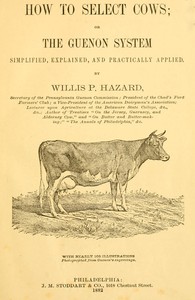
Before opening How to Select Cows or, The Guenon system simplified, explained, and practically applied — Reading Companion, the edition data offers a quick orientation: 46,896 words, 3 hr 24 min estimated reading time, and 14 detected text sections.
The text analysis averages about 20.1 words per sentence, while the detected sections provide another way to judge how the source is divided.
Project Gutenberg metadata also associates the work with “Cows,” connecting these edition facts with the source record’s subject description.
Explore this collection
These alternatives are selected using recorded categories and estimated reading time.
About 211 minutes
Livestock
48,506 recorded words. 7 minutes difference from this book's estimate.
View Gutenberg source #33074About 246 minutes
Livestock
56,372 recorded words. 42 minutes difference from this book's estimate.
View Gutenberg source #22520About 256 minutes
Livestock
58,734 recorded words. 52 minutes difference from this book's estimate.
View Gutenberg source #13730Search stored excerpts and compare books → Choose by your preferences →
Choices use stored catalog measurements. Estimates vary with reading speed. A shared category is a catalog label, not a claim that two books have the same argument or literary quality.
Search reads excerpt text stored with this catalog and links to its associated Gutenberg record. The connection is stored in the site database; this tool does not recheck that every excerpt is word-for-word identical to that external record. Excerpt search does not cover every chapter and does not verify historical publication dates.
Catalog snapshot checked: 2026-09-26. Coverage: 100 public books, 100 available source excerpts.
Calculated from edition completeness, EPUB availability, text structure and catalogue metadata. Not a user rating.
Total of 100 points, scaled to a 2.5-5.0 range. Editions with an empty description or a missing EPUB file are not scored.
Public-domain source text
The source text is kept in the dedicated reader, separate from this catalogue record and its commentary.
Willis P. Hazard opens his 1882 handbook by declaring that the "want has long been felt for a hand book which would simplify and explain the invaluable discovery of Guenon." The book aims to make Guenon's system of escutcheon marks—the patterns of hair on a cow's udder and rear—accessible to any farmer, so that "the superficial shall become thorough, the doubting acquire new faith." Hazard, secretary of the Pennsylvania Guenon Commission, writes from direct experience testing the system. The preface promises a sketch of Guenon, extracts from his preface, an explanation of escutcheon marks, descriptions of various escutcheons and their indications, and the commission's report. Nearly 100 illustrations are photographed from Guenon's own engravings.
Hazard insists that the reader must go "patiently, book in hand, into the farm-yard" to judge stock by the rules set forth. The escutcheon is not a theoretical curiosity but a practical gauge of a cow's milking capacity. In the excerpts, he describes specific escutcheon types: the "perfect curveline" found on bulls, and the "vertical or rear escutcheons" that "diminish as it rises, until, when within six to nine inches of the vulva, it is reduced to the breadth of not over an inch wide." These details are traceable to Guenon's engravings, which Hazard reproduces photographically. The system is presented as learnable by anyone willing to observe and compare.
Hazard warns that "while careful as to escutcheons, we must not neglect the other essential features of a good cow." He lists the "buckskin hide, the rich-colored skin, and the fine bone." He gives tactile tests: "grasping between the thumb and forefinger the skin at the rear of the ribs, or the double thickness at the base of the flank." Teats should be "well apart" and "large enough to fill the hand." He also emphasizes feeding: "the large yielder must be well fed." These practical instructions ground the system in everyday handling, not just visual inspection.
Hazard presents a detailed comparison of two Jersey cows, Rosa and Duchess, owned by C. L. Sharpless. Rosa, a five-year-old "solid creamy fawn," yielded 13.5 pounds of butter in a week on a diet of hay, meal, and carrots. Duchess, though "smoke-color, with brilliant white" and a "rich yellow" udder, was expected to be superior but proved less productive. Hazard notes that Rosa has a "pale skin and udder," yet her butter was "the deepest—no coloring matter being used." This case "upsets the theory that a yellow skin is essential for deep-colored butter." The comparison shows that escutcheon marks alone do not tell the whole story.
Hazard touches on heredity: a bull's escutcheon is "unexceptionable, being a perfect curveline," and his qualities "will be transmitted to his daughters." Yet he also admits that "we sometimes let our best animals slip," recounting that Rosa was nearly sold as a heifer for $500. The system is presented as a guide, not an infallible oracle. The excerpts do not reveal the full range of escutcheon types or the commission's final verdict, but they make clear that Hazard sees the system as a tool to be tested and refined by each farmer's own experience.
Hazard's handbook is best read with a cow in sight. The escutcheon marks are the core, but the book's value lies in its insistence on comparing multiple traits—hide, bone, udder, yield—and in its willingness to let a single cow like Rosa challenge received wisdom. The Pennsylvania Guenon Commission's report, included in full, adds an official stamp, but the real authority is the farmer's own judgment, sharpened by patient observation.
Holding this 1882 handbook, I recalled my grandfather’s quiet reverence for his herd, reading flank marks like others read scripture. Another old manual gave me that same hush—Determining the Age of Cattle by the Teeth — Text and Context—its tooth-wear charts feeling less like data than family portraiture. Both books measure time in the body’s small, patient language.
Create a short personal record of your experience with this book.