About 68 minutes
Wild Ducks: How to Rear and Shoot Them — A Closer Reading
Livestock
15,579 recorded words. 36 minutes difference from this book's estimate.
View Gutenberg source #28686
History of the Beef Cattle Industry in Illinois — Reading Notes can be approached with a clearer sense of reading commitment from its source measurements: 23,845 words, 1 hr 44 min estimated reading time, and 12 detected text sections.
The text analysis averages about 18.5 words per sentence, while the detected sections provide another way to judge how the source is divided.
Project Gutenberg metadata also associates the work with “Beef cattle -- Illinois -- History,” connecting these edition facts with the source record’s subject description.
Explore this collection
These alternatives are selected using recorded categories and estimated reading time.
About 68 minutes
Livestock
15,579 recorded words. 36 minutes difference from this book's estimate.
View Gutenberg source #28686About 45 minutes
Livestock
10,156 recorded words. 59 minutes difference from this book's estimate.
View Gutenberg source #45754About 29 minutes
Livestock
6,551 recorded words. 75 minutes difference from this book's estimate.
View Gutenberg source #36645Search stored excerpts and compare books → Choose by your preferences →
Choices use stored catalog measurements. Estimates vary with reading speed. A shared category is a catalog label, not a claim that two books have the same argument or literary quality.
Search reads excerpt text stored with this catalog and links to its associated Gutenberg record. The connection is stored in the site database; this tool does not recheck that every excerpt is word-for-word identical to that external record. Excerpt search does not cover every chapter and does not verify historical publication dates.
Catalog snapshot checked: 2026-09-26. Coverage: 100 public books, 100 available source excerpts.
Calculated from edition completeness, EPUB availability, text structure and catalogue metadata. Not a user rating.
Total of 100 points, scaled to a 2.5-5.0 range. Editions with an empty description or a missing EPUB file are not scored.
Public-domain source text
The source text is kept in the dedicated reader, separate from this catalogue record and its commentary.
Frank Webster Farley's 1915 thesis, submitted for a Bachelor of Science in Agriculture at the University of Illinois, opens with a detailed description of Illinois topography: 'nearly level' prairie, shallow streams that deepen near the Mississippi, and ponds that 'quickly became foul' under hot suns. This attention to land and water sets the stage for a narrative that ties physical geography directly to cattle-raising practices. Farley's prose is methodical, cataloging the state's surface features before introducing the people and their herds.
Farley devotes the first section of his thesis to the land itself, describing a landscape of 'slightly rolling' prairies cut by streams that form 'abrupt bluffs' near the Mississippi. He notes that ponds and 'sloughs' were once common, their water 'renewed only by the rains' and quickly fouled by livestock. This environmental detail is not mere scene-setting; it explains why cattlemen relied on natural water sources and why the introduction of silos and railroads later transformed the industry. The author's diction—'sluggish,' 'stagnant,' 'foul'—conveys a practical, unsentimental view of the land as a resource with limitations.
The chapter on pioneer drovers centers on Tom Candy Ponting, whose career Farley traces from 1848 to 1903. The narrative is built from specific transactions: Ponting's first drive to Chicago, his 1856 shipment by rail from Moweaqua, and his losses during the panic of 1857 when 'money became almost worthless.' Farley quotes Ponting's business decisions—buying 850 Texas cattle at $16 per head, contracting with the Wyoming Hereford Association—without embellishment. The voice is that of a chronicler, not a storyteller, yet the accumulation of dates, prices, and herd sizes gives the account a documentary weight.
Farley marks a turning point in the industry with Ponting's last overland drive to Chicago in 1855, noting that 'it is probable that they were the last bunch ever driven from central Illinois.' The author then details the railroad's role: in 1870, Ponting shipped 850 cattle over a new line from St. Louis to Pierce City, with railroad officers offering a $50-per-car refund to secure the contract. This anecdote reveals how infrastructure and corporate maneuvering reshaped cattle marketing. Farley's evidence—contract terms, car counts, and refund amounts—grounds the transition in concrete business history.
Farley documents Ponting's shift from feeding to purebred breeding, beginning with Shorthorn purchases in 1876 and moving to Herefords by 1880. The author records specific sales: a 1886 contract for 270 Herefords with the Wyoming Hereford Association, which left Ponting with a $800 loss when 60 cattle went unsold. Farley's treatment is clinical—'he lost about $800 on the deal, which killed all of his profits'—but the detail reveals the volatility of the purebred market. The thesis does not romanticize these ventures; it presents them as calculated risks with measurable outcomes.
Farley's thesis is a work of agricultural history grounded in primary sources—cattle sale records, railroad contracts, and personal accounts. Readers should approach it as a compilation of evidence rather than a narrative, noting how the author's choices in diction and structure prioritize factual precision over storytelling. The index, with headings like 'Cattle Plagues' and 'The Range Industry,' signals a systematic, chapter-by-chapter investigation of the industry's components.
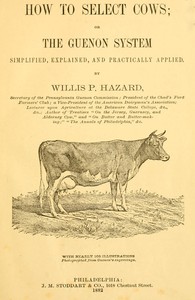
There’s something quietly tender about old agricultural records, the way they preserve the lives of cattle and the people who tended them, as if time itself had been folded into those pages. That Illinois history felt like a long, unhurried walk through a vanished landscape. I found a similar warmth in How to Select Cows or, The Guenon system simplified, explained, and practically applied — Reading Companion, a gentler kind of care lingering there too, like a hand resting on a wooden fence.
A brief reflection can help important ideas stay with you longer.