About 29 minutes
Louisiana Beef Cattle — Text and Context
Livestock
6,551 recorded words. 16 minutes difference from this book's estimate.
View Gutenberg source #36645
Before opening ABC Butter Making: A Hand-Book for the Beginner — Text and Context, the edition data offers a quick orientation: 10,156 words, 45 min estimated reading time, and 2 detected text sections.
The text analysis averages about 23.5 words per sentence, while the detected sections provide another way to judge how the source is divided.
Project Gutenberg metadata also associates the work with “Butter,” connecting these edition facts with the source record’s subject description.
Explore this collection
These alternatives are selected using recorded categories and estimated reading time.
About 29 minutes
Livestock
6,551 recorded words. 16 minutes difference from this book's estimate.
View Gutenberg source #36645About 68 minutes
Livestock
15,579 recorded words. 23 minutes difference from this book's estimate.
View Gutenberg source #28686About 16 minutes
Livestock
3,525 recorded words. 29 minutes difference from this book's estimate.
View Gutenberg source #26903Search stored excerpts and compare books → Choose by your preferences →
Choices use stored catalog measurements. Estimates vary with reading speed. A shared category is a catalog label, not a claim that two books have the same argument or literary quality.
Search reads excerpt text stored with this catalog and links to its associated Gutenberg record. The connection is stored in the site database; this tool does not recheck that every excerpt is word-for-word identical to that external record. Excerpt search does not cover every chapter and does not verify historical publication dates.
Catalog snapshot checked: 2026-09-26. Coverage: 100 public books, 100 available source excerpts.
Calculated from edition completeness, EPUB availability, text structure and catalogue metadata. Not a user rating.
Total of 100 points, scaled to a 2.5-5.0 range. Editions with an empty description or a missing EPUB file are not scored.
Public-domain source text
The source text is kept in the dedicated reader, separate from this catalogue record and its commentary.
Frederick S. Burch, editor of the Dairy World, opens his 1888 handbook with a frontispiece of a Jersey cow named Matilda 4th, signaling the practical, farm-level focus of the work. The table of contents reveals a methodical progression from milking technique through packing and shipping, with each chapter broken into short, actionable subheadings such as “The Slow Milker,” “To Raise Cream Quickly,” and “The Use of Annato.” Burch’s preface, though not fully excerpted, sets the tone for a guide aimed at beginners who need clear, step-by-step instruction rather than theoretical dairy science.
Throughout the excerpts, Burch returns repeatedly to the importance of temperature control. In the chapter on thermometers, he quotes Frederic Sumner: “There is no more use in trying to run a dairy without a good tested thermometer than there would be to attempt sailing a vessel without a rudder.” He dismisses the “thumb-rule” of earlier generations, noting that with butter prices at fifty cents to a dollar a pound, guesswork is no longer acceptable. Specific temperatures appear in the churning section: cream should be churned at 60 degrees, and the churn should start slowly. The maxims reinforce this, advising that “cream rises best in a falling temperature.” Burch’s emphasis on measurement over intuition is a recurring thread, distinguishing his handbook from older, more casual farm practices.
Burch devotes considerable attention to the final stages of butter making, where presentation affects sale price. He describes the risk of “woody taste” from wooden packages and recommends soaking them in strong brine for 24 to 48 hours, then scalding. A more reliable solution is lining the package with parchment paper, which “prevents the butter from taking on a woody flavor” and excludes air. He notes that parchment paper costs about thirty cents a pound and is sufficient for several hundred pounds of butter. For print butter, he mentions a machine that stamps out half-pound and one-pound blocks “very quickly and quite artistically,” with carved blocks that can imprint sheaves of wheat, acorns, or the maker’s monogram. He advises packing each churning separately to maintain uniform color and solidity, and sprinkling salt a quarter-inch deep on top before sealing the cover.
The section titled “MAXIMS FOR A B C BUTTER-MAKERS” distills the handbook’s advice into concise rules. Among them: “Test your cows,” “Never fill the churn over half full,” “Never touch the butter with your hands,” and “Never churn fresh unripened cream with ripened cream.” These maxims reflect Burch’s concern with common beginner errors—overfilling, contamination, and improper mixing of cream batches. The inclusion of a separate chapter by Mr. N. Bigalow on “How to Make Good Butter” suggests that Burch valued multiple expert voices. The overall structure, with its numbered chapters and index of illustrations, positions the book as a reference to be consulted during actual dairy work, not merely read.
Readers should note that the excerpts cover only the latter part of the text, including packing, thermometers, and maxims, but omit earlier chapters on milking, care of milk, and the milk room. The handbook’s full value lies in its sequential treatment of the entire butter-making process, from cow to customer. Burch’s advice is grounded in late-nineteenth-century American dairy practice, and his insistence on precision—especially with temperature—remains relevant for anyone interested in traditional butter production.
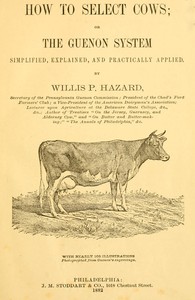
There’s something tender about that 1888 butter handbook’s insistence on patience—watching the cream, guarding the temperature. It makes me think of my grandmother’s quiet way with livestock, choosing each cow by temperament as much as lineage. That old companion volume, How to Select Cows or, The Guenon system simplified, explained, and practically applied — Reading Companion, sits beside it on my shelf like a whispered secret between two friends. Both speak of observation, not force.
Build a private reading journal entry for this title.