About 30 minutes
Rodent Control Aided by Emergency Conservation Work — Story, Setting & Ideas
Gardening
6,790 recorded words. 3 minutes difference from this book's estimate.
View Gutenberg source #59318
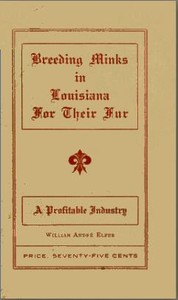
The catalog record for Breeding minks in Louisiana for their fur: A profitable industry — A Reader’s Guide provides practical reading context through 6,113 words, 27 min estimated reading time, and 1 detected text section.
The text analysis averages about 23.3 words per sentence, while the detected sections provide another way to judge how the source is divided.
Project Gutenberg metadata also associates the work with “American mink -- Louisiana,” connecting these edition facts with the source record’s subject description.
Explore this collection
These alternatives are selected using recorded categories and estimated reading time.
About 30 minutes
Gardening
6,790 recorded words. 3 minutes difference from this book's estimate.
View Gutenberg source #59318About 32 minutes
Gardening
7,146 recorded words. 5 minutes difference from this book's estimate.
View Gutenberg source #61555About 20 minutes
Gardening
4,437 recorded words. 7 minutes difference from this book's estimate.
View Gutenberg source #59748Search stored excerpts and compare books → Choose by your preferences →
Choices use stored catalog measurements. Estimates vary with reading speed. A shared category is a catalog label, not a claim that two books have the same argument or literary quality.
Search reads excerpt text stored with this catalog and links to its associated Gutenberg record. The connection is stored in the site database; this tool does not recheck that every excerpt is word-for-word identical to that external record. Excerpt search does not cover every chapter and does not verify historical publication dates.
Catalog snapshot checked: 2026-09-26. Coverage: 100 public books, 100 available source excerpts.
Calculated from edition completeness, EPUB availability, text structure and catalogue metadata. Not a user rating.
Total of 100 points, scaled to a 2.5-5.0 range. Editions with an empty description or a missing EPUB file are not scored.
Public-domain source text
The source text is kept in the dedicated reader, separate from this catalogue record and its commentary.
William André Elfer opens his 1909 manual with a preface declaring it “the result of experiments conducted by the author himself,” positioning the work as a firsthand guide rather than a theoretical treatise. He immediately frames mink breeding as a response to rising fur prices and growing scarcity, promising “profitable investment” to those who start early. The text then pivots to a detailed physical description of the American mink, borrowed from the Encyclopædia Britannica, noting small ears, bushy tails, and the gloss of northern versus southern pelts. This blend of personal authority and encyclopedic reference sets a dual tone: practical entrepreneur and careful naturalist.
The opening pages juxtapose two distinct voices. First, Elfer cites the Encyclopædia Britannica at length, describing mink size (head and body “fifteen to eighteen inches”), fur texture (“dense, soft, matted under-fur”), and color variation (“rich, dark brown” with occasional white patches). This borrowed description grounds the reader in biological facts before Elfer shifts to his own economic argument: “The fur market has always been a good market.” He notes a fifty percent advance in mink fur prices over the last two seasons, linking natural history directly to commercial opportunity. The transition from scientific observation to market speculation is abrupt but deliberate, suggesting that understanding the animal is prerequisite to profiting from it.
Elfer’s advice on acquiring breeding stock reveals a practical, if unsentimental, approach to animal welfare. He recommends employing trappers to catch minks with “No. 1 steel traps,” which “do not injure them very much unless they are permitted to remain caught too long.” He warns against buying animals with “badly-broken bones,” because “suffering will cause them to eat their leg off, in which case they will always die.” This passage is striking for its bluntness: injury and death are framed as financial risks rather than ethical concerns. The author’s focus remains on the viability of the breeding stock, not the animal’s comfort, reflecting the era’s utilitarian view of wildlife.
Elfer advocates for modest operations, stating “large farms are not necessary, and it is much better to have several small farms of six or ten acres than one very large one.” This preference for scale suggests an audience of individual investors rather than industrial corporations. He outlines plans to organize the “Louisiana Mink Company” to build farms and breed minks statewide, but the emphasis remains on accessible entry points. The author’s vision is one of controlled expansion: start small, trap carefully, and rely on rising demand to generate returns. The repeated phrase “profitable industry” underscores the manual’s core promise—that careful management will yield outsized rewards as wild mink become scarcer.
Elfer closes his argument with a speculative flourish, predicting that those who enter the business early will “command the fur market of both Europe and America.” He imagines a future where trapping is unprofitable due to scarcity, and prices “soar higher and higher.” This forward-looking rhetoric is tempered by the manual’s brevity—at just over 6,000 words, it offers little detail on daily husbandry or disease management. The author acknowledges plans for “a more elaborate work” the following year, suggesting this volume is a preliminary pitch. Readers should treat the financial projections as promotional rather than proven, and seek additional sources for practical breeding techniques.
Elfer’s manual is best read as a period document of entrepreneurial natural history—part species account, part investment prospectus. Its value lies not in comprehensive farming instruction but in its snapshot of early twentieth-century attitudes toward wildlife commerce. Readers interested in the practicalities of mink breeding should note the author’s promise of a future, more detailed work; this volume serves as an introduction to the industry’s economic logic rather than a complete guide.
Old Mr. Elfer’s mink manual holds a quiet patience—waiting for pelts to prime, for seasons to turn—and I find that same unhurried faith in Florida: An Ideal Cattle State — A Reader’s Guide, where the land is likewise asked to be what it already is. They share a gentler sort of ambition.
Your answers remain private and are stored only in this browser.









