About 40 minutes
Raising P. V. Squabs for Profit — Edition Insights
Gardening
9,179 recorded words. 1 minutes difference from this book's estimate.
View Gutenberg source #33371
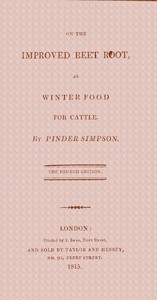
For On the improved beet root, as winter food for cattle — Reading Notes, the stored edition analysis reports 8,894 words, 39 min estimated reading time, and 11 detected text sections.
The text analysis averages about 19.0 words per sentence, while the detected sections provide another way to judge how the source is divided.
Project Gutenberg metadata also associates the work with “Beets,” connecting these edition facts with the source record’s subject description.
Explore this collection
These alternatives are selected using recorded categories and estimated reading time.
About 40 minutes
Gardening
9,179 recorded words. 1 minutes difference from this book's estimate.
View Gutenberg source #33371About 38 minutes
Gardening
8,542 recorded words. 1 minutes difference from this book's estimate.
View Gutenberg source #61611About 37 minutes
Gardening
8,510 recorded words. 2 minutes difference from this book's estimate.
View Gutenberg source #60710Search stored excerpts and compare books → Choose by your preferences →
Choices use stored catalog measurements. Estimates vary with reading speed. A shared category is a catalog label, not a claim that two books have the same argument or literary quality.
Search reads excerpt text stored with this catalog and links to its associated Gutenberg record. The connection is stored in the site database; this tool does not recheck that every excerpt is word-for-word identical to that external record. Excerpt search does not cover every chapter and does not verify historical publication dates.
Catalog snapshot checked: 2026-09-26. Coverage: 100 public books, 100 available source excerpts.
Calculated from edition completeness, EPUB availability, text structure and catalogue metadata. Not a user rating.
Total of 100 points, scaled to a 2.5-5.0 range. Editions with an empty description or a missing EPUB file are not scored.
Public-domain source text
The source text is kept in the dedicated reader, separate from this catalogue record and its commentary.
Pinder Simpson’s 1815 tract opens with a dedication to John Heaton, Esq., and an advertisement that frames the work as a practical report grounded in six hundred acres of Essex farmland. The author’s voice is that of an improving farmer, not a theorist: he writes of “observations, experiments, and calculations” made on a specific estate, and he addresses fellow farmers directly, urging attention to “strong soils” and the need for “green food” in winter. The fourth edition, he notes, incorporates “new lights” from correspondents, signaling a collaborative, evidence-based approach. Simpson’s prose is plain and purposeful, avoiding rhetorical flourish in favor of precise weights, measures, and dates. The text’s structure—a core treatise followed by an appendix of letters—mirrors its method: claims are supported by testimony from landowners and bailiffs across England, each letter a miniature case study in yield and cultivation.
Simpson’s narrative voice is that of a working farmer who values data over dogma. In the advertisement, he explains that the first edition’s circulation was “chiefly confined to a few of the inland counties,” but encouragement led to a fourth edition for “more general circulation.” This modesty is consistent: he credits John Heaton and his correspondents, and he is “restrained only by motives of delicacy from saying more” about his obligations. The prose is direct and unadorned, with sentences like “The best mode of cultivating this valuable root, with the greatest prospect of success, is a subject well worth the attention of farmers.” There is no attempt to elevate the subject into a grand theory; instead, Simpson lets the numbers speak. The tract’s rhythm is set by repeated references to weights—cwt., tons per acre—and to the practical challenges of clay soils, spring planting, and winter storage. This voice, at once authoritative and deferential, establishes Simpson as a trustworthy guide.
The appendix contains letters from farmers such as Jonathan Kendal and G. T. Boult, each reporting on specific plots. Kendal writes from Stag Brewhouse in 1814, describing “a tenacious loam, on clay, difficult to work in the Spring,” and gives a yield of “7 cwt. 2 qrs. on 6 yards by 10, which is after the rate of 30 tons per acre.” Boult, writing from Kentish Town, details a crop grown on “poor land, consisting principally of brick rubbish and road scrapings,” yet achieving “49 tons 4 cwt. per acre.” These letters are not mere endorsements; they are mini-experiments with precise methods—drill spacing, thinning distances, hoeing schedules. Boult notes that transplanted plants “did not succeed so well” as those sown in place, a candid observation that strengthens credibility. The correspondents’ voices vary: Kendal is terse, Boult more expansive, but both share Simpson’s focus on measurable outcomes. This polyvocal structure allows the reader to compare results across soil types and regions, reinforcing the tract’s central argument through accumulated evidence.
The tract’s pace is deliberate, shaped by the repetition of weights, dates, and distances. Simpson moves from general advice to specific calculations, then to letters, each section building a cumulative case. The opening advertisement is brisk, outlining the work’s scope. The main text, though not fully excerpted, likely proceeds methodically through cultivation steps. The appendix letters slow the pace, offering granular reports: “The latter end of April, 1814, ten poles of land were sown with Mangel Wurzel, 20 inches distance, in drills; the plants in the row thinned to about 15 inches.” Such sentences demand careful reading, mirroring the farmer’s own attention to detail. The effect is immersive: the reader is drawn into the rhythm of sowing, hoeing, and harvesting. Simpson’s own voice, when it reappears in the advertisement, provides a framing that prevents the letters from becoming a mere list. The overall pace is unhurried but purposeful, reflecting the slow, patient work of agricultural improvement.
Readers approaching this tract should attend to the interplay between Simpson’s authorial voice and the farmer-correspondents who populate the appendix. The work is not a polished treatise but a collaborative document, built from field notes and letters. Its value lies in the specificity of its observations—the exact weights, the soil descriptions, the candid admissions of failure. Simpson’s language, though plain, carries the weight of lived experience. To read it is to join a conversation among early nineteenth-century improvers, each contributing a piece of evidence to a shared project. The tract rewards those who read slowly, weighing each number and noting each place name.
I kept thinking about Pinder Simpson’s careful beet-root trials long after closing the pages—that quiet, methodical way he weighs one season against another. It reminded me, oddly, of an old book on Ponies past and present — Text and Context, where the same patient attention to small, tangible details makes something forgotten feel gently alive again.
Use these questions to collect your thoughts before moving on.









