About 92 minutes
The Airedale — Story, Setting & Ideas
Gardening
20,935 recorded words. 2 minutes difference from this book's estimate.
View Gutenberg source #43998
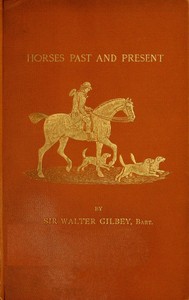
This digital edition of Horses Past and Present — A Reader’s Guide is described by source-level measurements including 21,421 words, 1 hr 34 min estimated reading time, and 3 detected text sections.
The text analysis averages about 22.9 words per sentence, while the detected sections provide another way to judge how the source is divided.
Project Gutenberg metadata also associates the work with “Horses -- England,” connecting these edition facts with the source record’s subject description.
Explore this collection
These alternatives are selected using recorded categories and estimated reading time.
About 92 minutes
Gardening
20,935 recorded words. 2 minutes difference from this book's estimate.
View Gutenberg source #43998About 97 minutes
Gardening
22,259 recorded words. 3 minutes difference from this book's estimate.
View Gutenberg source #67439About 90 minutes
Gardening
20,519 recorded words. 4 minutes difference from this book's estimate.
View Gutenberg source #67538Search stored excerpts and compare books → Choose by your preferences →
Choices use stored catalog measurements. Estimates vary with reading speed. A shared category is a catalog label, not a claim that two books have the same argument or literary quality.
Search reads excerpt text stored with this catalog and links to its associated Gutenberg record. The connection is stored in the site database; this tool does not recheck that every excerpt is word-for-word identical to that external record. Excerpt search does not cover every chapter and does not verify historical publication dates.
Catalog snapshot checked: 2026-09-26. Coverage: 100 public books, 100 available source excerpts.
Calculated from edition completeness, EPUB availability, text structure and catalogue metadata. Not a user rating.
Total of 100 points, scaled to a 2.5-5.0 range. Editions with an empty description or a missing EPUB file are not scored.
Public-domain source text
The source text is kept in the dedicated reader, separate from this catalogue record and its commentary.
Sir Walter Gilbey opens Horses Past and Present with a defensive apology for adding to the existing mass of equine literature, noting that over 4,060 books on the horse had been published by 1886. This self-conscious framing shapes the entire work: Gilbey positions himself as a compiler rather than an original researcher, yet his diction reveals a clear preference for official records and aristocratic sources. The text relies heavily on Racing Calendars, royal proclamations, and breed society data, while dialogue is absent—Gilbey instead paraphrases historical regulations, such as George II’s Act against small racehorses, in a detached, documentary style.
Gilbey’s introduction immediately establishes a tone of humility and justification. He writes that the book “is a compilation which, it is hoped, may prove useful as well as interesting,” and he feels compelled to apologize for “adding to the mass of literature on the Horse.” This defensive posture is unusual for a historical work and shapes the reader’s expectation of a modest, fact-driven narrative. The author’s voice remains consistently impersonal: he rarely uses the first person, preferring passive constructions like “it is not thought necessary” or “we are not informed.” This choice distances Gilbey from his material, presenting the history as an objective collation of records rather than a personal interpretation. The effect is a tone of scholarly caution, but it also limits the vividness of the narrative.
Gilbey’s treatment of racing history demonstrates a meticulous attention to numerical detail. He records exact weight scales for “Give and Take” plates, noting that a 12-hand pony carried 5 stone, with 14 oz. added per quarter-inch, so that 15 hands carried 11 stone. He also tracks changes in the King’s Plate Articles, quoting the original condition that “Six-year-olds shall carry 12 stone, 14 lbs. to the stone; three heats,” and then noting the 1773 footnote altering this to one heat. Such precise data points are typical of Gilbey’s method: he privileges official documents over anecdote. However, he occasionally admits gaps in knowledge, as when he states “We are not informed what weight the new scale required” for the Royal Plates after 1799. This honesty reinforces the compilatory nature of the work.
The narrative is organized chronologically by reign, from William the Conqueror to Queen Victoria, with each section centered on royal decrees and aristocratic practices. Gilbey devotes substantial space to the establishment of classic races like the Derby (1780), the St. Leger (1776), and the Oaks (1779), all under George III. He also highlights the role of individual breeders and riders, such as Sir Charles Bunbury, who bred Grey Diomed, and “Flying Childe,” who introduced fast riding to hounds in 1780. Yet the common horse—the cart-horse or the hunter used by ordinary farmers—receives far less attention. The book’s subtitle, “Saddle and Pillion,” and its frontispiece depicting a romanticized procession, signal a bias toward the horse as a symbol of status and sport rather than labor.
Gilbey’s descriptive passages are notably sparse. When he introduces the portrait of Grey Diomed, he offers only a brief factual caption: “foaled 1785, won many important races between 1788 and 1792, bred at Great Barton, Bury St. Edmunds, by Sir Charles Bunbury.” He does not describe the horse’s appearance or temperament, leaving the illustration to convey visual information. Similarly, the Norfolk Hackney breed is introduced through lineage—Blaze (1733) and Shales (1755)—rather than physical description. This economy of language suggests that Gilbey assumes his readers are already familiar with equine conformation and need only the documentary record. The illustrations themselves, such as “The Darley Arabian” and “Jacob Bates, The Trick Rider,” are listed but not analyzed in the text.
Readers approaching Horses Past and Present should expect a work that prioritizes official records over narrative flair. Gilbey’s authorial choices—his apologetic tone, reliance on numerical data, and focus on royal and aristocratic contexts—reveal a historian more concerned with accuracy than with evoking the lived experience of horses or their handlers. The book is best read as a reference for racing regulations and breed lineages, supplemented by its period illustrations. For those seeking a more sensory or populist account of equestrian history, this compilation may feel restrained, but it offers a valuable window into late-Victorian scholarly attitudes toward the horse.
Reading Gilbey’s careful apologies for the common horse, I kept thinking how much he loved the thoroughbred’s royal circles, yet missed the pony’s quiet stubbornness. His hesitations feel familiar—we all favor what we know. The Shetland Pony — Text and Context seems to answer that unspoken longing, lingering where Gilbey hurried past.
Answer a few questions and save a private reflection on this device.









