About 401 minutes
The Honey-Bee: Its Natural History, Physiology and Management — Key Ideas to Explore
Gardening
92,140 recorded words. 4 minutes difference from this book's estimate.
View Gutenberg source #67107
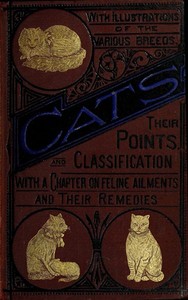
Before opening Cats: Their Points and Characteristics With Curiosities of Cat Life, and a Chapter on Feline Ailments — A Reader’s Guide, the edition data offers a quick orientation: 93,063 words, 6 hr 45 min estimated reading time, and 10 detected text sections.
The text analysis averages about 21.2 words per sentence, while the detected sections provide another way to judge how the source is divided.
Project Gutenberg metadata also associates the work with “Cat breeds,” connecting these edition facts with the source record’s subject description.
Explore this collection
These alternatives are selected using recorded categories and estimated reading time.
About 401 minutes
Gardening
92,140 recorded words. 4 minutes difference from this book's estimate.
View Gutenberg source #67107About 396 minutes
Gardening
91,014 recorded words. 9 minutes difference from this book's estimate.
View Gutenberg source #10009About 394 minutes
Gardening
90,404 recorded words. 11 minutes difference from this book's estimate.
View Gutenberg source #70382Search stored excerpts and compare books → Choose by your preferences →
Choices use stored catalog measurements. Estimates vary with reading speed. A shared category is a catalog label, not a claim that two books have the same argument or literary quality.
Search reads excerpt text stored with this catalog and links to its associated Gutenberg record. The connection is stored in the site database; this tool does not recheck that every excerpt is word-for-word identical to that external record. Excerpt search does not cover every chapter and does not verify historical publication dates.
Catalog snapshot checked: 2026-09-26. Coverage: 100 public books, 100 available source excerpts.
Calculated from edition completeness, EPUB availability, text structure and catalogue metadata. Not a user rating.
Total of 100 points, scaled to a 2.5-5.0 range. Editions with an empty description or a missing EPUB file are not scored.
Public-domain source text
The source text is kept in the dedicated reader, separate from this catalogue record and its commentary.
Gordon Stables, a naval surgeon and prolific Victorian author, structures this two-volume work around a striking contrast: the first volume collects anecdotal stories of cat sagacity and loyalty, while the second shifts to a more systematic treatment of breed classification, health, and training. The narrative voice itself changes pace accordingly—from the leisurely, moralizing tone of tales like “The Miller’s Friend” to the brisk, instructional prose of “Feline Ailments.” Readers should attend to how Stables weaves Scots dialect into dialogue, as in the miller’s “quo’ John” and “deevilock,” lending authenticity to his rural characters while his authorial commentary remains in formal English. This linguistic layering suggests a deliberate strategy to appeal both to sentimental pet owners and to readers seeking practical guidance.
The book’s two volumes operate at different tempos. Volume I proceeds largely through extended anecdotes—tales of cats that keep the Sabbath, honest cats, fishing exploits—each narrated with unhurried detail and a moralizing frame. Stables often pauses to address the reader directly, as when he calls sleep “Nature’s sweet restorer” before pivoting to a discourse on mental treatment. Volume II, by contrast, accelerates into a more compressed, encyclopedic mode: chapters on “Classification and Points” and “Tricks and Training” present information in brisk paragraphs, with less room for digression. The shift is most abrupt in the transition from the sentimental tale “The Miller’s Friend” (which closes Volume I) to the opening chapter of Volume II on the origin and antiquity of the domestic cat, where the prose becomes almost scholarly in its citation of historical sources.
Stables reserves Scots dialect for moments of heightened emotion or rustic authenticity. In “The Miller’s Friend,” the miller’s speech is thick with Scots forms: “I’ve been keeking at you from under the coverlit,” “that wee deevilock,” “I would rise this vera minute.” The narrator, however, describes the scene in standard English: “It was a clear frosty day outside, with the sky ever so bright and blue.” This code-switching creates a clear boundary between the authorial voice—educated, medical, detached—and the characters’ voices, which carry the emotional weight of the story. The effect is to frame the anecdotes as reported evidence rather than invention, reinforcing the book’s claim to factual authenticity while still indulging in sentimental storytelling.
Certain details recur across the excerpts, suggesting Stables’ thematic preoccupations. The cat’s purring and its placement on a sickbed—as when the miller takes the cat “into my bosom”—appears in multiple contexts, linking feline presence to healing. Food preparation is described with unusual specificity: the miller watches Nannie “crushing the hard edges with the knife, and seaming it across and across” to let butter penetrate the toast. Such minute attention to domestic ritual contrasts with the broader, more abstract discussions of cat breeds and diseases. Stables also repeatedly invokes the cat’s moral character—honesty, Sabbath-keeping, maternal devotion—using these traits to argue for the animal’s worthiness of protection and parliamentary consideration, a theme that surfaces in Volume II’s chapter on “Parliamentary Protection for the Domestic Cat.”
Because the excerpts are drawn from the opening and closing portions of the work, the middle chapters—particularly those on “Sagacity of Cats,” “Nomadism,” and “Tricks and Training”—remain largely unrepresented. Readers should note that the tone and pace may vary further within those sections. Stables’ habit of interspersing medical commentary with anecdote means that even the practical chapters likely contain narrative digressions. Pay attention to how he balances his dual roles as doctor and storyteller, and whether the Scots dialect appears only in the tales or also in the more instructional passages.
Reading how Stables moved from cat ailments to quiet tales of redemption, I found myself oddly reminded of those old emergency work pamphlets—practical manuals hiding a gentler purpose. His cats, like those project notes, were never just about utility. Both speak to a certain care for small things, the kind that lingers after the pages close. That particular one, Rodent Control Aided by Emergency Conservation Work — Story, Setting & Ideas, has that same unhurried voice to it.
Save your reaction, strongest insight, and memorable passage.









