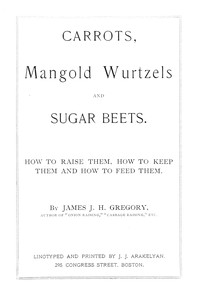
Gregory opens with a bold arithmetic: thirty-four tons of Swedes, nearly forty tons of carrots, and seventy-four tons of mangold roots have been raised per acre in Massachusetts, each supplemented by at least 15 percent leaf fodder. He uses these figures to argue that root culture yields far more nourishment per acre than hay, positioning it as the basis of good husbandry. The book is structured as a practical guide, with separate sections for carrots, mangolds, and sugar beets, each covering soil, manure, planting, cultivation, storage, and feeding.
The Chemistry of Manure
Gregory insists that a little knowledge of chemistry is of incalculable value to the husbandman, surpassing experience and traditionary knowledge. He provides a detailed table of the average composition of ash for root crops, including turnips, swedes, mangolds, sugar beets, carrots, and parsnips, as well as leaf ash. For mangolds, he lists the mineral ingredients in order of importance: potash, soda, chlorine, lime, phosphoric acid, magnesia, sulphuric acid, silica. He then identifies cheap sources: unleached wood ashes and German potash salts for potash; muriate of potash or waste salt from fisheries for soda and chlorine; carbonate of lime or wood ashes for lime; bones or coprolites for phosphoric acid; and plaster for sulphuric acid. This systematic approach reflects his belief that the great advance in agriculture will come from applying chemical analysis to manuring.
Varieties and Their Distinctions
The carrot section lists seven varieties: Early Very Short Scarlet, Early Short Scarlet Horn, Short Horn, Danvers Carrot, Guerande Carrot, Long Orange or Long Surry, and Large White Belgian. For mangolds, Gregory categorizes varieties into long, round, and ovoid types, and offers guidance on what kinds to grow. He does not provide detailed descriptions of each variety in the excerpts, but the structure implies that selection depends on soil and purpose. The sugar beet is treated separately, though the excerpts do not include its variety list. This attention to varietal choice suggests that Gregory expects the reader to match root type to local conditions and market demands.
Yield and Feeding Logic
Gregory frames root culture as a cycle: high yields of roots, when fed on the premises, increase manure products, which in turn boost subsequent crops. He cites yields of up to seventy-four tons of mangolds per acre, with leaves adding fodder value. He notes that carrots and mangolds are subject to but few diseases, contrasting them with early turnips. The feeding section, though only partially excerpted, is clearly oriented toward practical farm economy. Gregory also mentions that ploughing under leaves after topping benefits the following year's crop, linking root growing to long-term soil fertility.
Gregory's manual is best read as a period-specific blend of empirical observation and emerging agricultural science. Readers interested in historical farming methods will find detailed instructions on bed preparation, manure application, and storage, while those studying the history of agronomy can trace how chemical analysis began to reshape practical advice. The book's value lies not in novelty but in its systematic, data-driven approach to a narrow subject.
That rainy afternoon, Gregory’s careful chemistry of manure and roots kept me quiet for hours, the slow arithmetic of feeding soil feeling almost meditative. Afterwards, I picked up another old manual, its pages just as patient, and found the same unhurried logic hummed through the hives—a different crop, yet the same tender management. Bee Keeping for Profit. A New System of Bee Management (1880) First Edition. — Text and Context felt like a neighbor’s barn, not a classroom.